Four weekly issues in, we’re still experimenting with the Briefing’s format and frequency. This week our own Leader Interview leads, and I’ve let the agency and reading sections run longer, to five items each, because there was more worth your time. Feedback is appreciated, as always: reply and tell me what you’d keep, cut or add. – Michael
Billy Partridge, Grayling’s UK Chief AI Officer, told me the result he’s proudest of this year is that nobody at the agency is afraid to say no to AI. This week I share how he makes that work, what Bing’s new AI reports reveal about where AI cites you, what a week with Gemini in Gmail taught me, and why Meta’s AI ad terms now start on 20 November.
From Comms With AI
Not a dirty word: making it safe to say no to AI. Our Leader Interview with Billy Partridge is now written up on Applied, with a listening edition in which every quote plays from the moment it was said. Billy runs AI adoption as advocate and sceptic at once: the advocates do most of the testing and training, and the sceptic dial goes up for technical development and investment decisions. The context Grayling’s AI works from is built client by client, and each project now has a named person who keeps it up to date. Any automated workflow gets a human stop before the first step that can’t be undone. His most quotable line: “I don’t mind if we never turn to AI for whole swathes of our business, if it just protects the quality that we produce.” I also work with Grayling as a freelance digital and social director. Read and listen on Applied
From Applied
Cited 774 times in a day: what Bing’s AI reports show, and the gap they expose (4 November), on Applied Comms With AI. Bing Webmaster Tools’ AI Performance report showed Microsoft Copilot and its partners citing commswith.ai 774 times across 39 pages on 1 November. On the same day, Google Analytics showed no visits from Copilot at all. A citation carries your framing to people who may never visit, so I argue it should be reported like coverage rather than traffic. Bing’s report is free, and so far no other AI platform shows site owners this much. Read on Applied
Leaving Substack or Ghost without losing a reader: an AI-assisted migration checklist (5 November). How we moved Applied from Ghost onto commswith.ai between 12 and 15 October, with Claude doing most of the build and me approving every switch. All 80 old addresses became 154 redirect rules, each tested before and after the switch; Google’s Change of Address was filed; and the email list was invited across rather than copied, because consent to one newsletter does not carry over to another. If your team will one day move or close a newsletter, microsite or campaign hub, the checklist is the part to keep. Read on Applied
A week with Gemini: worth switching on in Gmail, if you check its sources (6 November). I made Gemini my main assistant for the week of 2 November on our Google Workspace account. In Gmail it earned a daily place: its AI Overview pulls related emails into one summary with sources, and its suggested drafts now know enough about the people involved that I send more of them as they are. Its summary of one search also made two errors, naming the wrong site and turning a share of search impressions into “28% of total traffic”, which is exactly the kind of slip a busy reader passes straight on. In the Gemini app its answers trailed Claude’s and ChatGPT’s. If you run Workspace, switch it on for email, open the sources before acting on any summary, and check whether the Gemini app is a core service on your edition before anyone uploads client material. Read on Applied
What the agencies are doing
Agencies are saving time with AI, and losing track of where it goes. Spark AI’s autumn report, from more than 350 agency professionals, finds that 91 per cent now save time with AI, double the 2025 share, yet 45 per cent say the saved time is absorbed or hard to account for, and only 6 per cent have turned it into new AI revenue models. It also finds 44 per cent of agencies have an AI policy that no one checks, and 55 per cent have no formal stance on telling clients about AI use (PRmoment, 5 November; Spark AI’s own findings). If you hire an agency, ask in writing how it discloses AI use on your account and where the time saved shows up in fees or output. Read
When an agency changes hands, its AI platform goes too. Avenir Global, owner of Hanover, Madano, Padilla and SHIFT, has bought Next 15’s tech PR network Marker Collective, home to Archetype, Outcast and Nectar, with about 650 staff in 20 offices, for a reported £70.4m (Marketing-Interactive and Earned First, 5 November). The three agencies share an AI media intelligence platform, Delve, which Avenir plans to try across its wider network. If you are a client of any of them, ask what happens to your data in Delve and whether the tools or terms change under the new owner. Read
Ruder Finn puts technology, data and AI under one person. Tejas Totade becomes global chief technology officer and chief data and AI officer, to “build the architecture that supports the agency’s AI capabilities end to end” and widen tool access and training in every region (Ruder Finn, 2 November). When you brief an agency, ask who holds that job there and what its AI does on your account. Read
Monitoring meets the journalist database, with a warning about volume. Truescope and Telum Media have started a partnership in Australia, New Zealand and Singapore, joining media monitoring and analysis with journalist intelligence and distribution (PRovoke, 4 November). Truescope’s chief executive, John Croll, warns that using AI to chase volume gives PR “the old problem, only faster”, and Telum’s Michael Webster says the flood of AI-written pitches puts the premium on relevance. It is not a UK option yet, but the point travels: if AI makes pitches cheaper, measure your hit rate and relevance, not releases sent. Read
OpenAI gives its top comms job to a corporate affairs specialist. Jill Hazelbaker, previously president and chief corporate affairs officer at Uber, with earlier communications and policy roles at Snap and Google, will lead OpenAI’s global communications and corporate positioning (OpenAI, 3 November). The hire suggests OpenAI now handles public trust in AI as a corporate affairs matter, so expect its announcements to lean on regulation and reputation, and read them with that in mind. Read
Tools and models
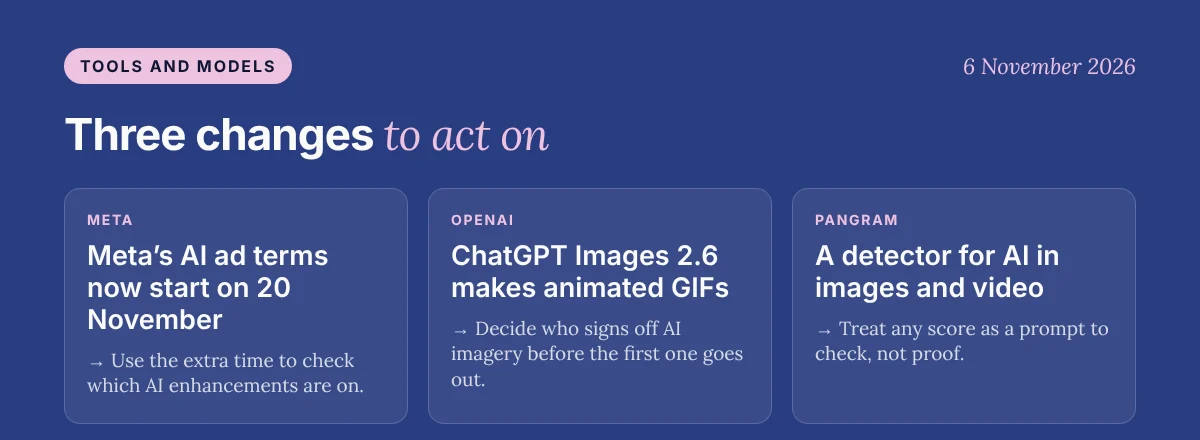
Meta’s AI ad terms now start on 20 November. A correction to last week’s issue: Meta had already moved the start of its revised Commercial Terms and Self-Serve Ad Terms, including the AI section we covered, from 30 October to 20 November, after publishers and advertisers complained to EU and UK competition authorities (PPC Land, reporting Reuters, 23 October). Meta disputes that the terms give it unlimited rights to use their content for AI, and an Editor and Publisher op-ed reports that the date could move again. Use the extra time to check which AI enhancements are switched on in Ads Manager and to read the content-use terms before they apply. Read
ChatGPT images now animate. OpenAI’s Images 2.6 is live in ChatGPT on every plan, in Codex and in the API. OpenAI says it generates 50 per cent faster, keeps characters, products and brand details more consistent across edits, handles posters and product layouts better, and can now make animated GIFs, such as a mascot or a product loop (OpenAI, 4 November). Anyone in your organisation can now make an on-brand social GIF without a designer, so decide who signs off AI imagery and what gets labelled before the first one goes out. Read
A detector for AI images and video. Pangram has taken its AI image detector out of research preview: Image 1.0 checks images and shows a heatmap of where AI appears, Image Flash 1.0 checks video frame by frame, and both come with a Chrome extension and an API (Pangram, 4 November). Pangram says it holds up against edits, compression and low resolution, on its own benchmarks. It gives a team a quick check on images supplied by the public or an agency before they run; treat any score as a prompt for a human check, not proof. Read
Test it yourself
Put a stop before the step you can’t undo
Pick one workflow where AI drafts, summarises or sends something for your team, and map it in the Approval Workflow Mapper. Mark the first step that can’t be reversed, such as publishing, sending or paying, and name the person who checks the work just before it. That is Billy Partridge’s rule, written down.
Open the Approval Workflow Mapper →Worth reading
- Where the £400bn figure came from. Answering a parliamentary question, AI minister Kanishka Narayan said AI adoption could add £55bn to £140bn to the UK economy by 2030, with a central estimate of £120bn that he called “hugely uncertain”. The £400bn figure the government used for about two years came from a 2023 report Google commissioned from Public First (Wired, 4 November). If the £400bn line is in your AI messaging or business case, replace it, and check who commissioned any headline AI figure before you use it. Read
- Journalism’s share of AI citations is falling. Muck Rack’s fourth “What Is AI Reading?” report, drawn from 207 million citations in AI answers this year, finds journalism’s share fell from 27 per cent in May to 22 per cent, the largest shift across its four editions, while owned media rose from 13.7 to 15.2 per cent and earned and third-party sources still make up more than 84 per cent (Muck Rack, 28 October). At its summit, Muck Rack also proposed tracking an “error rate”: how often AI gets your facts wrong (via Gab Ferree’s Comms Besties). It is Muck Rack’s analysis of its own data, but the practical point holds: your About and product pages now matter alongside your coverage. Read
- Anthropic’s first news licensing deal, according to Adweek. Two unnamed sources told Adweek that Anthropic signed a content licensing deal with the Associated Press just before the US midterms, so Claude showed attributed AP election updates on election night; neither company commented, and terms were not disclosed (Adweek, 4 November). Adweek says OpenAI already has more than a dozen such deals. For media relations, coverage in wire and licensed outlets may now count for more in AI answers. Read
- An AI mandate nobody can describe is a briefing problem. Google’s “Beyond AI Optimism” research finds 91 per cent of organisations have an “AI-first” mandate, but only 42 per cent of employees say it has been clearly defined in their daily work, and executives are 13 per cent more likely than knowledge workers to say AI has improved work (Google Workspace, 21 October). It is Google’s own research, but the gap is an internal comms job: explain what the mandate means in each role. Read
- Bylines without the writer. Press Gazette found 28 casino articles carrying the byline of a former Esports Insider writer on the site’s German pages, updated months after he was made redundant. “I never wrote or touched any of it, and couldn’t have,” he said (Press Gazette, 26 October). If you publish bylined content, add two lines to your AI-use policy: a named person approves every piece under their name, and leavers’ bylines are retired. Read
Events
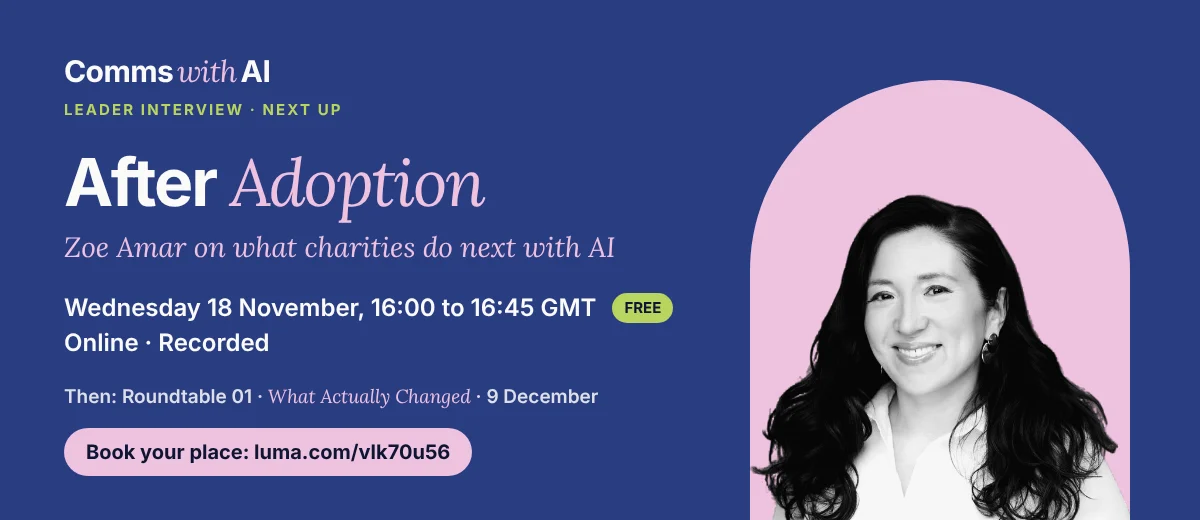
Wednesday 18 November, 16:00 GMT: After Adoption, with Zoe Amar. Zoe chairs the Charity Digital Code of Practice and co-authors the Charity Digital Skills Report. Bring the question your organisation hasn’t settled yet, whether that’s governance, AI imagery in sensitive work or what to tell supporters, and put it to her live. Free, online and recorded. Book on Luma
Wednesday 9 December, 12:00 GMT: What Actually Changed, Comms and AI in 2026. The first Comms With AI Roundtable asks whether AI changed how comms work gets done this year, with Darryl Sparey of Hard Numbers, Emma Ewing of Big Fish Training and Kerry Parkin of The Remarkables, and every theme anchored in something published in 2026. An hour, free, online and recorded. I also deliver training with Big Fish. Book on Luma
Elsewhere: Thursday 26 November, 10:00 to 15:35 GMT: CharityComms AI Conference. CharityComms’ online day, Leading Strategy, Building Skills, covers sector benchmarks, shadow AI, governance and risk, brand voice, knowledge bases and AI-related reputational crises, with speakers from Full Fact, Tearfund and the Ada Lovelace Institute. £120 to £295 + VAT a place, by member type. Event page
Pass it on. If a colleague would find the Briefing useful, the signup is at commswith.ai/applied, and their first email brings a one-page AI acceptable use note to adapt for their team.
Talk it through. A Consult Comms With AI session is 45 minutes with Michael and a written advisory note you can act on. Book a session