note Monitor
Cited 774 times in a day: what Bing's AI reports show, and the gap they expose
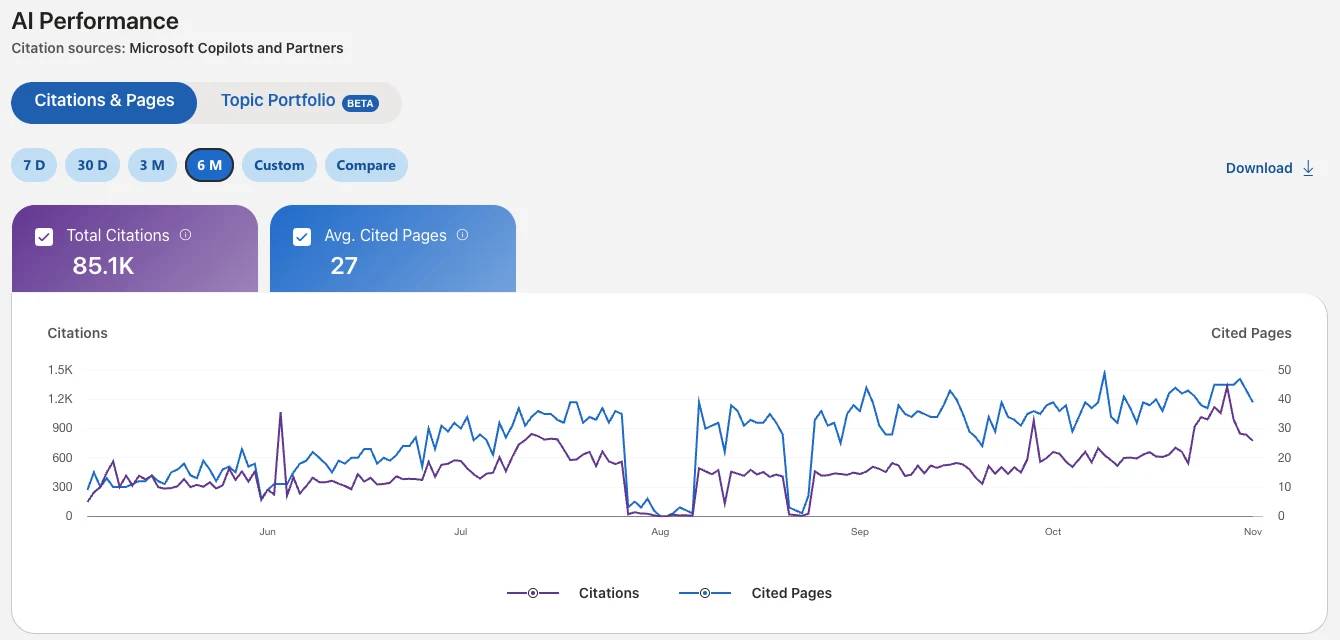
Microsoft Copilot and its partners cited commswith.ai 774 times on 1 November, yet Copilot sent no visit I could see. Bing is the only AI platform showing site owners this much, and the rest need to catch up.

The Brief
- What happened: Bing Webmaster Tools has added Topic Portfolio, in beta, to its AI Performance report. On 1 November it showed Microsoft Copilot and its partners citing commswith.ai 774 times across 39 pages.
- Why it matters for comms: It is the most concrete first-party view of AI visibility I’ve had – and it shows how far citations and clicks have come apart. That same day, Google Analytics showed no visits from Copilot, and the four AI visits it did show came from ChatGPT and Meta AI, which tell me nothing about when they cite us.
- The takeaway: Put Bing’s AI Performance report into your monthly reporting now, read your analytics with more suspicion than before, and treat a citation like coverage, not like traffic.
- Model
- Microsoft Copilot, Bing AI summaries and partner AI experiences, as reported by Bing
- Surface
- Bing Webmaster Tools AI Performance and Topic Portfolio (beta); Google Analytics 4
- Runs
- One read of both reports, with CSV exports
- What went in
- commswith.ai's own Bing citation data from 4 May to 1 November 2026, and its Google Analytics traffic for 1 November
The Story
I’ve written about how hard it is to know what AI engines say about you (Gullible engines) and about paying a tool to estimate it (The dashboard said we were winning). Bing’s report is the first time the estimating stops, for one platform at least.
What Bing shows you
The AI Performance report counts how often Microsoft Copilot, AI summaries in Bing and some partner AI experiences cite your pages as a source. A citation is a link in an answer: not a visit, and not a person.
For commswith.ai, over the 30 days to 1 November, it counted 22,032 citations, with about 40 of our pages cited on an average day. In May, the daily average was about 346 citations; in October, about 728.
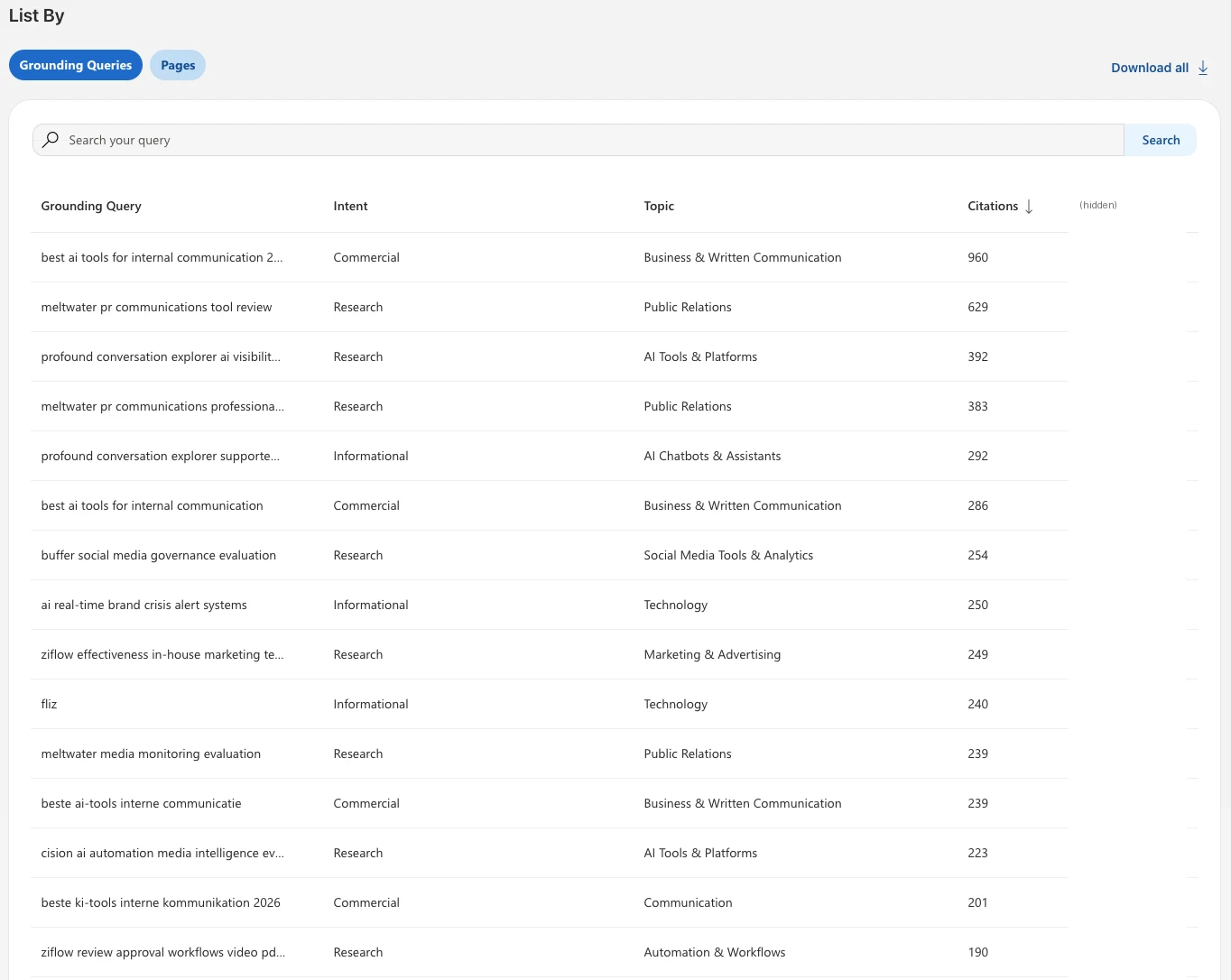
The grounding queries are the most useful part: the phrases the AI searched with when it went looking for sources. Ours are led by “best AI tools for internal communication”, followed by people asking AI to evaluate Meltwater, Buffer, Cision and Ziflow, the questions our tool reviews set out to answer. Two of the top 15 are in Dutch and German, for pages written in English.
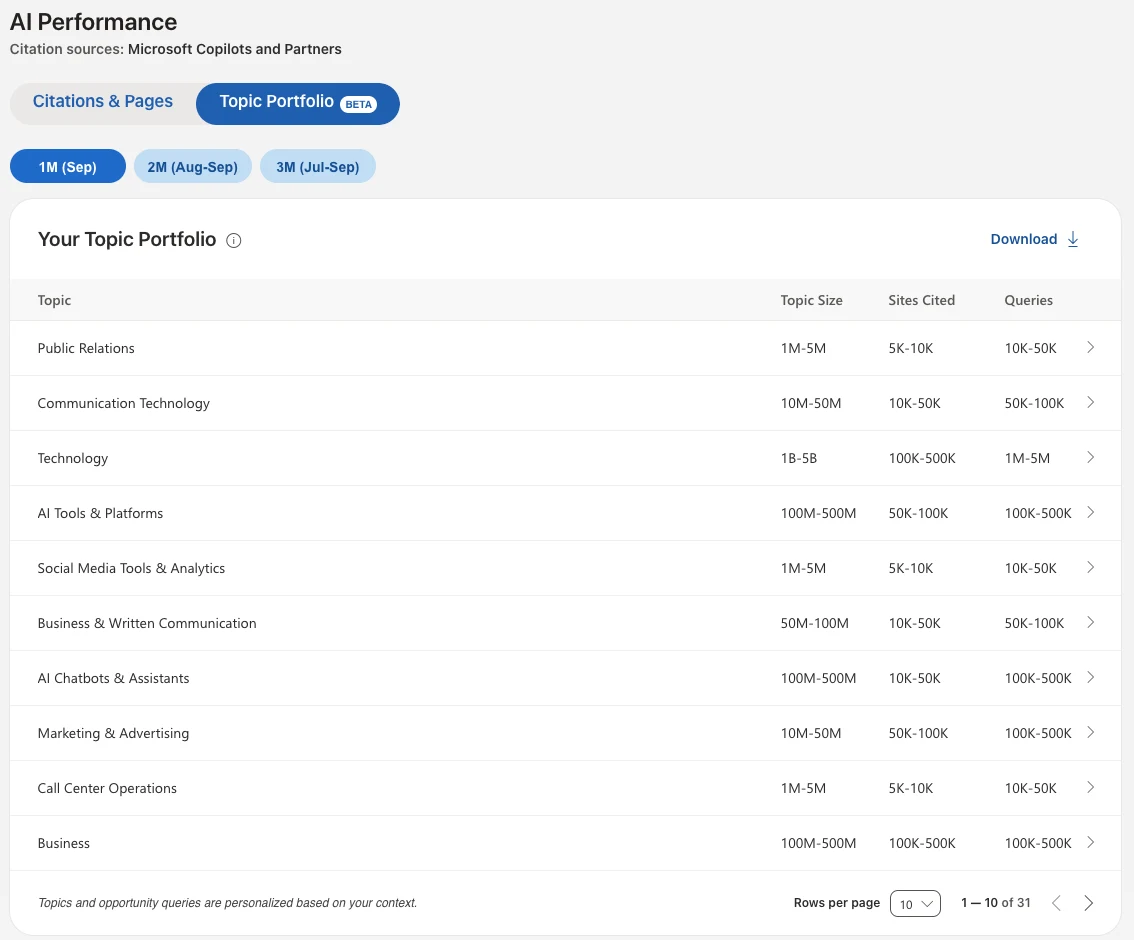
Topic Portfolio, announced on 13 October, groups those queries into topics. For each it gives the size of the topic, how many sites get cited in it and how many queries it holds, then lists opportunity queries where other sites are cited and yours is not. It is useful for planning, with limits: the figures are wide ranges (“1M-5M”), Microsoft says the topic labels are AI-generated and may be inaccurate, and our portfolio only runs to September. (Full feature list and limits are in our directory entry for Bing Webmaster Tools.)
What it can’t show you
Here is the other half of 1 November, from Google Analytics. The site had 69 active users. We filter out territories and areas that send obvious bot traffic, and we’re adding other technical giveaways to that filter as we find them; that took out 20 users, or 29%, before a single person arrived. Even the 49 left include visits from Council Bluffs and The Dalles, both home to Google data centres.
Of the sessions that remained, six came from Google search, three from ChatGPT, one from Meta AI and one from LinkedIn. None came from Copilot or Bing. Forty-two were “direct”, which is also where AI traffic that arrives without a referrer ends up.
So 774 citations from Copilot produced no Copilot visits I can see, and the AI platforms that did send people don’t report when or why they cite us. One day is a small sample, but the two halves come from different companies, and neither half joins up.
For comms teams, that is a familiar problem in a new place. A citation carries your framing to someone who may never visit, which makes it closer to earned coverage than to web traffic. Reporting it as traffic will always make it look like failure.
What I’d like from OpenAI, Anthropic and Google
Google’s generative AI report in Search Console now shows impressions in AI Overviews and AI Mode, but no queries and no clicks. I can’t find anything comparable for site owners from OpenAI or Anthropic. If they want comms, PR and marketing teams to work with their tools properly, they need to give us first-party data on when and why they cite us, and make it available to the monitoring and analytics tools we already use, not one more dashboard to log into. Until then, much of AI visibility work stays guesswork.
The Practice: what you can put into practice today
- Verify your site in Bing Webmaster Tools and read the grounding queries. It’s free. The queries are the questions people are putting to AI about your area, which is a brief in itself.
- Pick one opportunity query from Topic Portfolio. Find one where competitors are cited and you’re not, and check whether you have a page that answers it directly.
- Strip out the bots before you report. Check which territories and sources are sending traffic that never engages, filter them out, and report citations alongside visits, the way you’d report coverage alongside enquiries.
Are you reporting AI citations to your leadership yet, and if so, against what?
Every Applied piece follows the same shape (The Brief, The Story, The Practice) and is made the same way: my argument and examples, drafted with Claude, every claim checked against its source, and a final edit by me. This one: 21 claims checked.
Coming up: the next Comms With AI Leader Interview is After Adoption: Zoe Amar on What Charities Do Next with AI, online on Wednesday 18 November, 16:00 to 16:45 GMT.
A note: one test, one result, dated. Figures checked against the source, product names and versions checked, drafted with Claude, edited by me.
21 claims checked against their sources.
More like this
experimentMonitor
The dashboard said we were winning: I paid a GEO/AEO tool to track my firm's AI visibility for a monthWhat a paid AI visibility tracker told us about the same site, and why we did not believe it.
experimentMonitor
Gullible engines: what AI says about you, and the free way to check your GEO/AEO visibilityWhat AEO and GEO mean, and a free way to check what the engines say about you.
articleMonitor
The lag problem: Comms With AI in the Monitor phaseWhy monitoring is where comms teams get AI measurement wrong.