interview Govern
Not a dirty word: Billy Partridge on making it safe to say no to AI
Grayling's Chief AI Officer runs adoption as advocate and sceptic at once. His proudest result of the year is that nobody at the agency is afraid to say no to AI, and the mechanism behind it is one any comms leader can copy.


Billy Partridge

Billy Partridge is Grayling UK’s Chief AI Officer. He leads the agency’s UK AI strategy and is responsible for driving business transformation with AI. He is also a corporate reputation and crisis comms specialist, oversees Grayling’s Scottish operations from Edinburgh, and joined the agency in 2009 after starting out at its sister agency CDR in the City of London. We spoke on Wednesday 28 October. And a disclosure up front: I’ve worked with Grayling over the past year and a half, as a freelance digital and social director, and Billy recommended me for it, so we know each other. I’d valued his conversations previously – especially his thoughtfulness and prescience when it comes to AI – so was excited to speak with him in depth on the record.
The Brief
- The claim: Your clients want the scepticism. “They need you to know when to stop,” Billy said. Grayling has “absolutely no issue in saying no to AI. None at all, and I hope that’s forever the case.”
- The evidence: Fenced-in AI is “umpteen times better”, and keeping the fence is now somebody’s job. Context is built “client by client, source by source”, refreshed often, and “the responsibility of specific individuals”. The tell for unfenced work: “too generic, too vanilla… too AI”.
- The takeaway: Make scepticism an acceptable stance in your team, out loud, and give the sceptics the build and spend decisions – where it earns most.
This was a Comms With AI Leader Interview, our live series with leaders in communications and AI, recorded on Wednesday 28 October. The full conversation is below as a listening edition, and every quote here plays from the moment it was said. Upcoming sessions are on the Comms With AI events page.
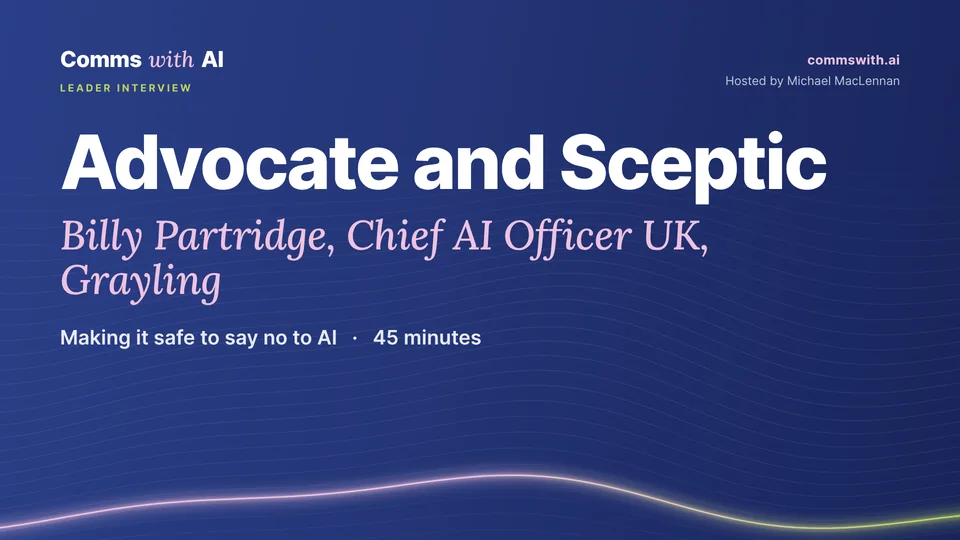
A listening edition: Zoom kept the title card on screen rather than our faces, so this is the audio with captions and chapters over the card. Every timestamp in the piece plays the recording from that moment.
The Story
I asked Billy, at the end, what he most hoped he had embedded at Grayling this year. Rather than reeling off a stat or exceeded goal, he provided a counterpoint – describing what the agency doesn’t do. “We’re not very draconian about AI usage. There’s no Big Brother, no checks on what you’ve typed in or how many times you’ve clicked enter.”
Then the thing he is proud of: “I never wanted AI to be a dirty word… I hope we’ve achieved that, mostly by being very accepting of scepticism – by that being okay, by that being a good thing.” 42:19
Both sides of the seesaw
The ‘advocate and sceptic’ line, which he used in AI Magazine in August, “wasn’t a line we created from nowhere. It dawned on me quite early on that both sides of that seesaw would be needed.” 1:53 The reason is trust, and AI, “despite all of its wonderful benefits – I’m a huge advocate of AI – can erode trust very, very quickly”. 2:36
There is no ratio. “I don’t have a metric on how much we’re sceptical and how much we’re advocates, because it depends on each and every opportunity, prompt, and circumstance.” 3:24 What there is, is a division of labour. Billy tries “to imbue a healthy amount of scepticism” in Grayling’s advocates, and with the sceptics he does the reverse. 19:41 The advocates “do most of the testing”, the lunch and learns and the on-the-job training. 21:21
There’s a subtle art in how he then applies thinking on the other side: “Scepticism is much more at the fore in the technical development we’re going through… your sceptic dial is pretty high at that point”, and investment decisions are on the same list. 21:39
What settles arguments is the work, whichever way a person leans: “The work still has to be fantastic – that is a leveller in terms of personal points of view.” 20:58
Who keeps the fence
Where the advocates have clearly won is context. “Fenced-in AI performs markedly better. Its outputs are more usable, more trustworthy. That first draft just happens umpteen times better.” 7:14 For clients comfortable with enterprise AI, Grayling’s tool of choice is ChatGPT, and the context lives in projects, and building it “wasn’t a lazy process – it was a very deliberate process, client by client, source by source.” 8:01
What struck me is who owns it. Those projects “are now updated frequently, and it’s the responsibility of specific individuals to do that.” When Billy was learning the craft, “that just wasn’t a responsibility. But now, when you’re an account manager, it absolutely could be. AI context. Who knew?” 8:22
This was something I recognise from my own set-up. There is a working memory file at the top of each of my folders, one at the root and others in the subfolders for the different parts of what I do, which tells my current tool of choice, Claude, what is where and what the rules are. It has been built up over the year as I widened its access (including to ChatGPT as an additional check).
However, it can also mean things go stale and the fence rots. When Applied moved onto Comms With AI on 15 October, instructions and links still pointed at the old address. When I froze Notion a week later to run my content calendar as a Claude artefact instead, skills still told the assistant to update the Notion calendar. When you’re the named individual in charge of the project, “it’s becoming pretty obvious when AI is not fenced in” cuts both ways: you’re the one who owns the responsibility when speaking to your bosses or the client.
I put the sceptic’s question to him: does good context ever make AI more confidently wrong? He accepts that “your own confidence in the output will be higher, inevitably” 12:32, and his answer is cultural: “People are always wrong. But being wrong isn’t the end of the world” 11:23, and “the mistake itself is nowhere near as important as the recovery from it.” 12:06
Where the stop goes
Agents at Grayling are “in trial form, being used in the business in very controlled ways”, on operational rather than client work. 14:11 The benchmark for any workflow is “improved. Not replicated, but improved”. 14:49
The tension he keeps meeting is that people want more automation than he does. Show someone a prototype and they ask for it to “do this bit too… eating into a workflow that I just want them to do, with no contribution from a robot at all.” 17:06 On AI acting for people, his line is a “watching brief”. It “doesn’t yet happen at all commercially” at Grayling, because “what we don’t want to do is erode the client/agency contract – that unspoken trust that the work you’re getting is of the highest possible quality. I don’t know if clients are ready for that to be outsourced.” 23:53
His rule for where a person comes back in: take a workflow that reads an inbox and ends in a report. Ask too much of it “without checks and balances, because human beings are innately looking for shortcuts, innately happy to trust, innately wanting to complete tasks”, and the risk goes up. 27:05 Then: “Insight A might inform decision B, and if you’re not happy with insight A, decision B might lead to something in C and D, which you can’t undo.” 27:34 Grayling has hit it in testing “an awful lot… where you’ve just asked too much, or you’ve not inserted a stop.” 28:16
Working out where those stops go, step by step, is the unglamorous part of the job, and he does not pretend otherwise. It is “the part of the jigsaw that a lot of people don’t understand or want to get involved in” 27:49, “a gritty process… in-the-weeds, in-the-trenches” 28:00, and the only way through is to “be prepared to roll your sleeves up and keep going until you find a good solution.” 28:49
Where the stop goes
Move the human check along Billy’s inbox-to-report workflow
Six steps, drawn from his example on the recording. Everything before the stop runs on its own; a person reads the result before anything after it happens. Two steps cannot be undone. Illustration: the steps are ours, the rule is his.
- Read the inbox The agent reads the morning’s mail.
- Summarise it It writes up what came in.
- Insight A It says what matters today.
- Decision B It decides what to do about it.
- Action C It replies to the client. Cannot be undone
- Action D It books the follow-up. Cannot be undone
Steps 1 to 4 run without anyone looking. A person checks the decision before step 5, the first one that cannot be undone. This is where Billy puts it: before the irreversible step, not after.
How good is my team, full stop
A colleague asked Billy this week how she could tell how good her team was at using AI. “I just think it’s the wrong question.” That question ought to be: “How good is my team, full stop?” 29:58 He doesn’t mind simple prompts that get “a brilliant outcome” 30:22; what he wants is “the deliberate use of the prompts. It’s knowing why you’re prompting the way you are.” 32:01
You don’t, as he put it, have to be “the Good Will Hunting of AI” to get it. 32:24
You don’t have to be the Good Will Hunting of AI, an absolute brain box, to get it. You just have to be purposeful about it.
AI comes up in appraisals too, which he would hope is “treated no differently to any other aspect of learning and development”. 34:48
And the limit? He told the whole agency about a Steps musical he went to see (written, as it happens, by my multitalented former ITN colleague and playwright Shaun Kitchener), and “how little AI could have had to do with the connection made with the audience… a brilliant example of what AI will never be able to do, and how it’s almost ridiculous to expect it to.” 37:04 Then the line a Chief AI Officer rarely says in public: “I don’t mind if we never turn to AI for whole swathes of our business, if it just protects the quality that we produce.” 38:13
I don’t mind if we never turn to AI for whole swathes of our business, if it just protects the quality that we produce.
The Practice: what to borrow from Billy
- Say it out loud, then organise it. Tell your team it is fine to be both. Then turn the sceptic dial up where he does, on technical development and investment decisions, and let the advocates run the trying-out and the training. (The policy templates in the Comms With AI governance library are where to write it down.)
- Put a name on every piece of context. Each client or organisation your AI works from gets an owner and a refresh habit, the way Grayling’s account managers now own their projects (how to set up the folders). Read incoming work for the tell: too generic, too vanilla, too AI.
- Put the stop before the first step you can’t undo. Map any automated workflow A to D, as Billy does, and put the human check before the first irreversible decision. Expect to have asked too much at the first attempt; he did.
His hope for next year is a plain one. “I’d love to talk to you again in a year’s time and be able to say we’re just a better business than we were a year ago.” 43:22 Which begs the question: what would your team have to stop doing with AI to be able to say the same?
Every Applied piece follows the same shape (The Brief, The Story, The Practice). This one was drafted with assistance from Claude, with every quote and claim checked against its source.
Coming up: the next Comms With AI Leader Interview is After Adoption: Zoe Amar on What Charities Do Next with AI, online on Wednesday 18 November, 16:00 to 16:45 GMT.
67 claims checked against their sources.
More like this
interviewTransform
Three numbers: Stephen Waddington on making the case for comms in 2027The budget conversation Billy's "better business" test will have to survive.
articleTransform
How to set up project folders in ChatGPT and Claude for comms workThe fence, built step by step: project folders in ChatGPT and Claude.
articleGovern
AI in crisis comms: where it helps and where it hinders, stage by stageFor Billy's point that a simulation tests how a crisis feels, not what technically happens.