experiment CreateGovern
I cloned myself for a promo video. Why on earth would a comms team?
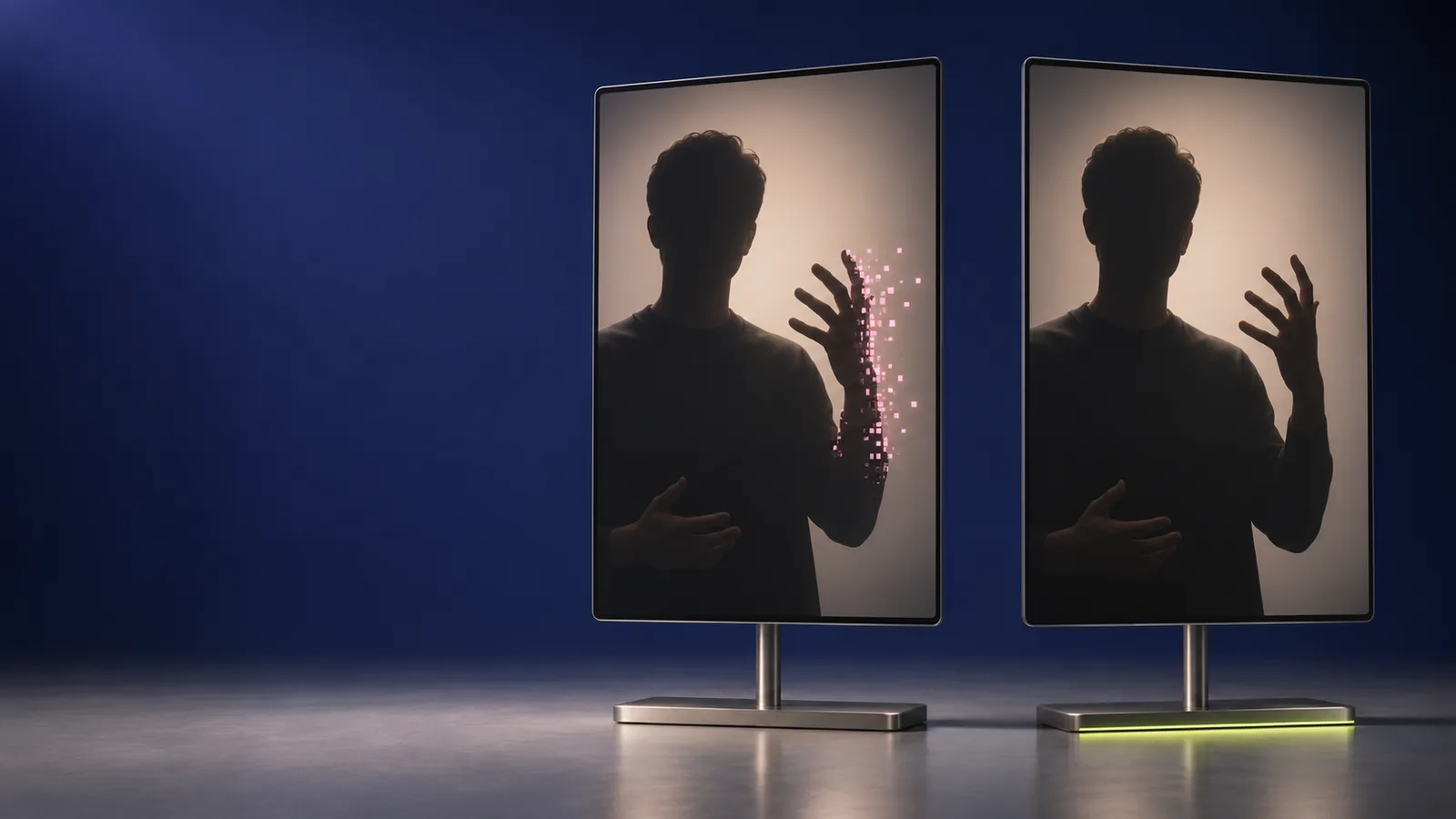
I ran one promo script through Synthesia, HeyGen and Google Vids, then let HeyGen's newest model clone me. The clone read my script better than I did and fooled the person who knows me best, which is the best argument I've found for keeping AI presenters off your organisation's name.

The Brief
- The result: AI presenter video is now good enough to fool someone who knows you better than anyone – and that is the best reason I can find for keeping it well away from your organisation’s name. Worse, my clone read my script closer to what I meant than I could, so the ick alone won’t keep it out of anyone’s future.
- What we did: I ran one 50-second promo script for my January masterclass through Synthesia, HeyGen and Google Vids on their free or included plans, then had HeyGen’s new Avatar 6 build a clone of me to read the same script, then read it myself.
- The takeaway: Watch what an AI presenter can do now, then write down where your organisation will never use one. Then be ready for the harder question: the clone may be better at being you than you are.
- Model
- Synthesia stock avatar; HeyGen AI-designed avatar ('Lip sync' model) and Avatar 6 clone of the author; Google Vids AI avatar
- Surface
- Synthesia Basic (free); HeyGen Free; Google Vids on a Google Workspace Business account
- Runs
- Two rounds per tool, then one Avatar 6 clone and one take by me
- What went in
- One 126-word promo script for a Faur masterclass, four on-screen cards, the Faur logo and a disclosure line; for the clone, one photo and a 22-second recording of me. No client material.
The Story
I played a promotional video featuring myself to a loved one, for some gentle critical feedback. Her first piece of advice, delivered with the patience of someone who has had to look at far too much of my handiwork, was that I should look at the camera more (fair, and entirely my own doing, since the wandering eyes came straight from the clip I’d recorded for it…).
Then I told her it wasn’t me. “Oh my God,” she exclaimed, pulling a face I can’t adequately describe, and once she’d recovered: “I totally thought it was you … that’s absolutely bonkers.”
Same script, same room
Which one is me?
Both clips read the first two sentences of the promo. One is me; one is HeyGen's Avatar 6 clone of me. Watch both with the sound on, then vote.
-
Clip A
-
Clip B
Which is real?
B is me. A is the clone. Both are cropped to a square from the same frame, which also takes HeyGen's watermark out of the clone.
Let me say it now, before anyone at HeyGen gets their hopes up: I’m not going to use it, and I don’t think your organisation should either, which is an odd place to land after a week spent making the things – though not as odd as watching yourself count off five points on fingers you never moved.
How we got here
Two years ago this wasn’t a question worth asking. When Synthesia launched its Expressive Avatars in April 2024, the promise was that they would appear “less robotic and more lifelike” (TechCrunch), the bar at the time being to look a little more lifelike than Zoltar, the fortune-telling machine in Big. A year later, a reviewer found HeyGen’s Avatar IV “quite uncanny” from a single photo, give or take “a random, generic AI voice” (Why Try AI).
On Tuesday, HeyGen launched Avatar 6 with the line “84% of people couldn’t tell it from the real person” – which is its own test of its own product (treat it the way you’d treat any company marking its own homework!), but my test had a sample of one, and the one couldn’t tell either (and would know better than anyone else I know…).
The test that came first
I didn’t set out to clone myself. The plan was a sober comparison: a 126-word promo for the masterclass I’m running in January, read by a stock presenter in Synthesia, HeyGen and Google Vids, on the plans most comms teams would start with, with cards, captions and an “AI-generated presenter” label. The renders took minutes and looked good, and the work was everything after them, so if you do go ahead, budget for the edit. Synthesia, given the real spelling, called my company “Fower”; HeyGen dropped a man in a cap into the office behind my presenter three seconds in, uninvited and unexplained; and Google Vids, the easiest of the three to adjust and the one that cost me a morning, played two voices reading my script slightly out of step before captioning me as “Michael McLeanen, founder of four”.
Renders from 19 November 2026, on the free or included plans. Sound on.
None of which matters as much as it should, because at a glance, which is how most people watch anything on a phone, all three were passable, and that is the part that ought to worry us.
Then I made one of me
I’ll tip my hat to HeyGen here, because the quality has come on at a startling pace and the process is very well done: a photo, a 22-second clip of me reading HeyGen’s own script (“Hey there! I’m speaking with LOTS of energy”), and a voice cloned from it in three flavours, one that sounded like me (a bit dour, I’ll concede before anyone else does), one that sounded very English, and one so hyper-energetic it seemed to be the version of me social video has been waiting for all along, which naturally is the one I picked. While it built, HeyGen invited me to “give Michael MacLennan more outfits and backgrounds”, roughly the moment the experiment turned into The Sims (the automotive mechanic look, I’m sorry to report, is a paid upgrade), and when it was ready the script screen told me, without a flicker of irony, “This is exactly what Michael MacLennan will say.”
And it did. It said Faur properly, in my own room with my own lamp and posters behind it, and it added gestures I never made, counting the masterclass’s five parts off on its fingers like a primary teacher at story time. “I wouldn’t have thought it wasn’t my hands,” was my note at the time, and the one giveaway I’ve found since is a wedding ring, sitting conspicuously on hands which are not actually my hands. It looked like me, it sounded like me, and the one thing the person who knows me best could find wrong with it was something I did.
Then I tried to beat it
Having watched the clone, I sat in the same chair and read the same script myself, and it took me about 66 seconds against its 45, with a long pause in the middle while I lost my place and a “Boot by … Book by 18th December” flub at the end that no amount of energy could rescue. “I’d have to do at least a few more takes,” I told the camera, before admitting it was “becoming a bit of a reaction video now”. The clone got it in one, and that is the part that’s boggling my brain: there’s a version of this that delivers what I want more seamlessly than I do, more in keeping with what I actually meant, and it isn’t misrepresenting anything, because it is me, my words and my voice, and at the same time it isn’t. “In some ways it’s more how I want me to be for this,” was how I put it, before searching for the off button (which, I noted, is definitely not what the AI would do).
Why on earth would you?
You wouldn’t, though my reason has shifted in the space of an hour, in a manner which has quite frankly startled me. Before I watched my clone I’d have said these videos carry none of the personality or the DNA of the organisation they speak for; then I remembered the chief executive pieces to camera I’ve helped make over the years (and there have been a few), and the clone already matches the most excruciatingly awkward of them, and beats some. The risk is reputational. The voices are still a bit flat and a bit static if you listen properly, and the AI people in my YouTube adverts still give me the ick, but the damage comes the day a viewer spots a small detail out of place (a wedding ring on the wrong hands, say), or simply notices that every video is framed and delivered the same way, and asks for the clarity you’d rather not give: was that really them? The trust lost then won’t come back with a disclosure label.
For Faur, where the point of booking anything is that you deal with me, a convincing not-me in front of the offer would quietly cancel the one promise that matters. The industry’s answer is “disclose it and get on with it”, and Google duly announced a “How this ad was made” panel for ads on Search and YouTube in July (PinMeTo), tucked behind a three-dot menu where every viewer will no doubt go looking (they won’t, because by then they’ll have been suckered in, which is rather the point).
Which leaves the decidedly more philosophical question I can’t shake. If the clone uses my face, my voice and my words, and lands them closer to what I meant than I can, who exactly is being misled? My answer, for now, is the person who books: the masterclass is live, the Michael who turns up on 28 January will stumble over “book by 18 December” like everyone else, and a promo that sells a smoother me than the one you’ll get is a small lie told very well. Ask me again in a year (though I suspect plenty of people won’t wait that long to decide it’s fine).
None of which will stop it. Somebody with fewer scruples and a bigger content calendar is going to put a clone of their chief executive in front of a camera that never switched on, it will be cheaper than a film crew and quicker than the chief executive’s diary, and half the audience won’t notice, so strap yourself in. Watch what these tools can do, show your leadership, write your line down, and when the pitch arrives offering your boss in 12 languages by Friday without the inconvenience of your boss, you’ll already have your answer, and you can provide the firm ‘no’ in your own voice.
The Practice: what you can put into practice today
- Find out what you already pay for. Google Vids comes with Workspace business editions, with a monthly allowance of AI avatars (Google help). Check who in your team could make one this afternoon, because if they can, someone eventually will.
- Write your line into your AI policy. Use the disclosure section of our AI use policy template to say where a synthetic presenter, or a clone of a real person, will never speak for you. Ours, for now, is that we won’t use one at all, and we’ll say so here if that ever changes.
- Read the terms before anyone uploads a face. HeyGen’s terms let it use what you upload to train its models, and on self-serve plans the way out is an email (HeyGen security). Free-plan videos are licensed for personal, non-commercial and internal evaluation use only, which is why the clips here are shown as part of this test and nowhere else.
The masterclass in the test script is real: From inbox to invoice, a live online morning on setting up AI across a consultancy, freelance practice or agency of up to about 10 people, on Thursday 28 January 2027 (faur.site/masterclass).
My argument and examples, drafted with Claude in my voice, every claim checked against its source, and a final edit by me. The test plan was first drafted with ChatGPT. Comms With AI has no commercial relationship with Synthesia, HeyGen or Google.
More like this
articleTransform
Tool testing: our review methodologyHow we test the tools in the Comms With AI directory, and why we write up what failed.
articleCreate
The volume problem: Comms With AI in the Create phaseThe Create phase, where volume comes quickly and quality takes the work.
noteCreate
A week with Gemini: worth switching on in Gmail, if you check its sourcesA week with Gemini on the same Workspace account, from the inbox side.