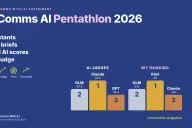
One 80-word brief turned six of our articles into an illustrated, interactive companion in 55 minutes. What do we gain, and what do we lose, when something that took months now takes an hour?
Q4 2026 edition. A plain-English guide for communications professionals who are new to AI, or who use it now and then: where things stand, the four main assistants and what each is good for in comms, five things to try this week, and the words you keep hearing. Refreshed every quarter.
2027 planning rounds are asking comms teams to turn their AI use into savings. Stephen Waddington's answer: make the case in the three numbers management cares about, price the judgement work, and ask for budget for the new work AI creates.
In conversation with Stephen Waddington, Professional adviser, Wadds Inc.
Applied now lives on Comms With AI. All 44 pieces moved with their dates, every old address leads to the same piece, and from today every piece names the template, tool or phase it puts to work.
A paid AI visibility tracker ranked my consultancy first for a month. On the questions a buyer would ask without our name in them, AI engines named us in about one answer in nine.
A fabricated award on one web page was repeated as fact by three chatbots. Here is what AEO and GEO actually mean, what the visibility tools do and do not buy you, and a free way to find out what the engines say about your organisation.
AI systems are built on language, steered by language and increasingly speak on an organisation's behalf. That makes communication part of how the technology behaves, and hands comms a job nobody else in the building is trained for.
A lot of AI output feels generic, and one reason is that the model has no idea what your organisation has already said, approved or decided. Here is where a durable memory can live, ten practices that keep it trustworthy, and three things you can do today.
Hundreds of AI agents attacked Hugging Face without once asking a human for help. Ethan Mollick's response points at a future that needs exactly the skills comms people already have.
Most comms professionals use one layer of AI, the chat window, and assume that is all there is. Here are the five layers, from chat to autonomous agents, and the comms job each one is for.
AI's leading voices are losing the communications war because they are fighting a publicity war instead. They are spending on the message and neglecting the fundamentals.
Ask a room of communications professionals what stops them getting value from AI and you tend to hear the same one or two answers: it makes things up, or the lawyers will not allow it. Both are real. Neither is the whole picture.
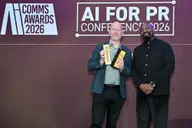
Three months ago I documented building Comms With AI with Claude Code. On 18 June it won Gold at the inaugural AI Comms Awards, and I was named AI Communications Leader of the Year.
Most AI initiatives in communications do not fail because the tools fail. They fade because nobody owned the change. This final article in the series is about the difference between a clever pilot and a capability that lasts.
Most monitoring tells comms teams what happened after the moment to act has passed. The Monitor phase asks a sharper question: how quickly can your team detect, interpret and respond to what is happening now?
Ben Verinder has researched AI in public relations for eight years. In this Comms With AI Leader Interview, he explains why the policy gap everyone talks about sits on top of a deeper one: an honesty gap between teams, agencies and the people they serve.
Every efficiency gain in the Create phase lands as a workload increase in Govern. More content, produced faster, still has to be checked, approved, and stood behind. This article is about the phase where AI created the problem before it offers any of the solution.
Most AI adoption in communications starts with content creation. The test that matters is whether agent-assisted work still meets the standard senior communicators would trust in public.
Most AI conversations in communications start with the draft. That framing misses where quality is actually set – in the research, positioning, stakeholder mapping, and message architecture that happens before a single sentence gets written.
Most teams use AI a tool or a prompt at a time. This piece introduces the Comms With AI 5-phase framework, which maps how AI agents fit into communications work from strategy to transformation, with three worked scenarios.
Rik Turner spent 15 years helping brands win at search. Then Google AI Overviews changed the rules. In this Applied Comms With AI interview, he explains why PR teams are now central to how brands are represented in AI-generated search results – and shares a practical framework for responding.
NOAN CEO Neal Mann explains the idea of a living fact layer, why hallucinations are structural rather than accidental, and what communications leaders need to rethink before AI can deliver real value.
In conversation with Neal Mann, CEO and co-founder, NOAN
Build an ICP “target reader” as an AI agent to stress-test headlines, CTAs and template copy in hours – and fix clarity, proof and governance gaps fast.
Seven iterations, one recursive workflow. The behind-the-scenes account of preparing and delivering a live AI demonstration for The Data Lab – and what the process actually taught me.
Two weeks letting Claude Cowork reorganise the files behind my business: what it handled, what needed oversight, and why it removed the friction that stopped me writing at all.
How I built a brand skill from scratch and produced a full campaign toolkit – speaking proposal, presentation, content calendar, outreach emails – in a single session.