article Transform
AI agent-driven communications: a practical framework for transforming how comms teams actually work
Most teams use AI a tool or a prompt at a time. This piece introduces the Comms With AI 5-phase framework, which maps how AI agents fit into communications work from strategy to transformation, with three worked scenarios.


Editor’s note, October 2026: Comms With AI now calls this the 5-phase framework. The five phases are unchanged, and the framework lives at commswith.ai/framework.
Communications has a workflow problem.
Communications teams sit at the convergence of reputation, narrative, stakeholder expectation, and organisational change.
Meanwhile, the external environment has accelerated – 24-hour news cycles, heightened public scrutiny, digital complexity at scale – but internal workflows have largely not kept pace. Most teams still operate on processes designed for the early social media era. Monitoring is manual, content production ad hoc and decision-making reactive, with planning cycles that assume more stability than the world offers.
AI is often introduced tentatively and tactically: someone asks ChatGPT for a first draft; a team experiments with a tool without integrating it into anything else. Results are inconsistent, enthusiasm fades, and when the next tool arrives the cycle repeats.
This short-termist, time-restricted tactical framing misses the real shift.
AI can be more than a second-class writing shortcut, and certainly more than automation for its own sake. The more useful way to think about it: AI is a workflow engine. The question that matters is “which part of our workflow should we redesign first?”
This article introduces a framework for answering that question. It is the foundation for a six-part series that works through each part of it in depth.
What AI Agents Are
An AI agent is a structured, task-specific system that performs a defined function consistently (and hopefully also reliably). Unlike a one-off prompt to a language model, a well constructed agent has a clear purpose, rules and constraints, predefined inputs and outputs, and the ability to produce repeatable results.
With an agent, you set a task.
That distinction matters more than it might seem. A conversation is inherently open-ended: useful for exploration, problematic for operations. An agent is infrastructure. It executes a defined function every time, in the same way, with the same quality floor. That is what makes agents interesting for communications work: the reliability of the process.
Why communications work suits this model particularly well
Communications work is high-volume, high-stakes, multidimensional, and deadline-driven. It involves repeatable research processes, predictable governance steps, structured briefs and outputs, and a constant need for consistency across channels, time, and tone.
The comms work combo – of repetition, structure, and high stakes – is exactly what agent-based design is built for. It gives teams a way to operate with more rigour and less friction. It does that by cutting the groundwork that needs human judgement.
Introducing the Comms With AI 5-phase framework
To make AI agents useful for communications work, they need a framework that maps to how communications teams actually operate.
The Comms With AI 5-phase framework is built for exactly that.
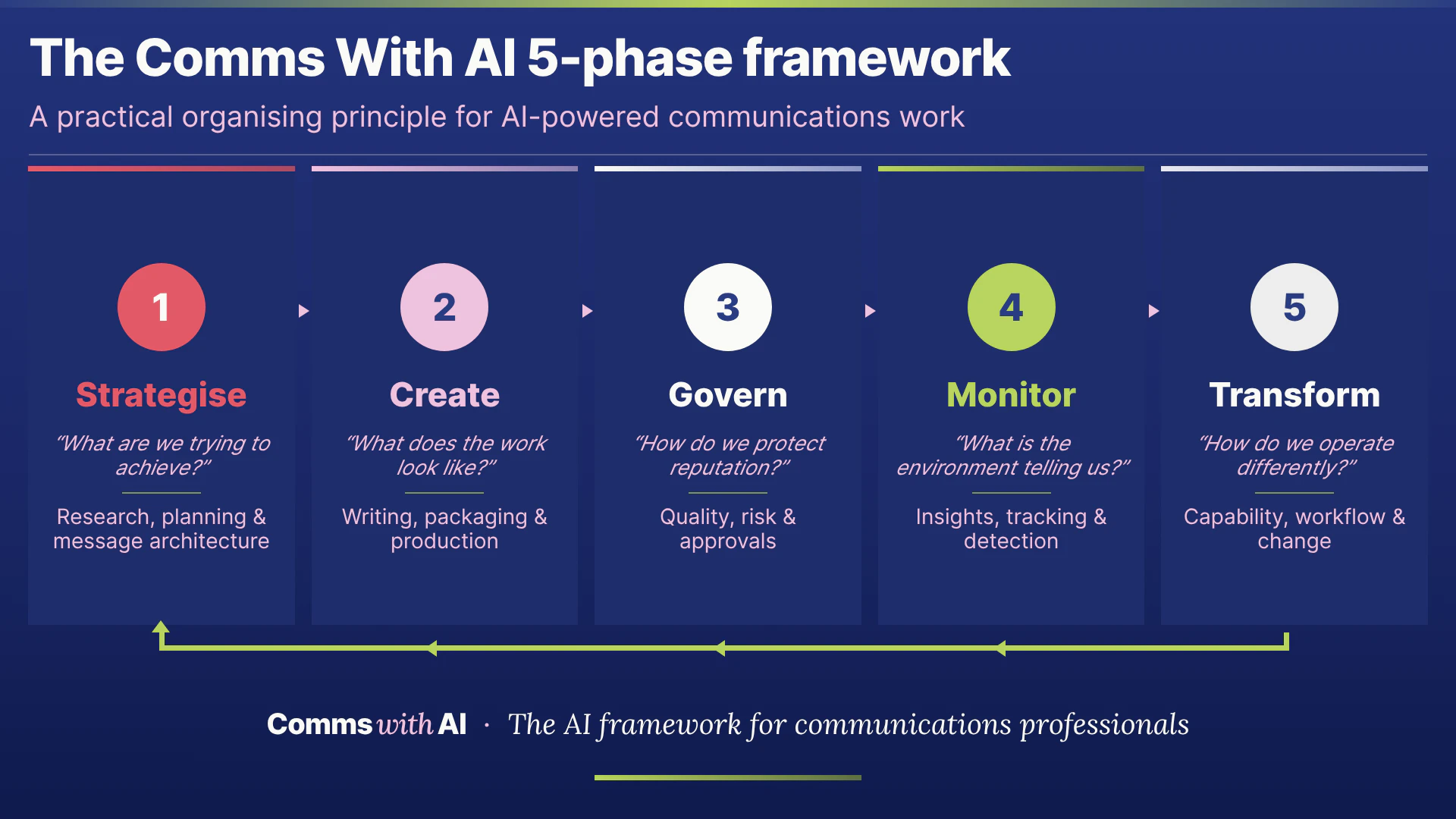
The 5-phase framework describes the full cycle of communications work with AI. It is a map of the territory, a structure that reflects how communications work moves:
- Phase 1: Strategise. Research, planning, audience analysis, stakeholder mapping, positioning, message architecture. The intelligence layer that informs every decision downstream.
- Phase 2: Create. Writing, content production, multi-format packaging, narrative development, editorial planning. Turning strategy into tangible communications outputs.
- Phase 3: Govern. Quality assurance, risk management, compliance checks, approval workflows, tone verification, claims substantiation, accessibility, crisis preparation. The control layer that protects reputation.
- Phase 4: Monitor. Media monitoring, issue tracking, sentiment analysis, stakeholder reporting, campaign measurement, competitive intelligence. The intelligence layer that reads the environment.
- Phase 5: Transform. Capability building, workflow redesign, AI readiness assessment, team training, tool selection, organisational change management. The layer that improves how the whole system operates.
These phases form a cycle. Each feeds the next. The output of Phase 5 feeds back into Phase 1. Communications work is not linear: teams move between phases constantly as campaigns develop, issues emerge, and organisations mature.
Update, October 2026: this framework was first published as the Comms With AI Operating System. It is now the Comms With AI 5-phase framework; the phases are unchanged.
The framework organises the template library, provides the process model for training, connects individual tools to a bigger picture, and gives teams a diagnostic for assessing their own capability.
How the Phases Work Together
The easiest way to understand the framework is to see it operating in real situations. Three brief scenarios illustrate how communications challenges move through the five phases.
Scenario 1: A product launch campaign
A B2B technology company is launching a new product. The comms team has three weeks and needs to coordinate messaging, content, approvals, and measurement across multiple channels.
- They begin in Strategise: defining audiences, building the message house, mapping stakeholders, setting objectives. AI agents accelerate the landscape analysis and audience profiling – work that would previously take several days of research can happen in hours.
- They move into Create: drafting the press release, social variants, blog content, email sequences, internal announcements. AI agents produce first drafts from the agreed message house; human review shapes them for voice, nuance, and strategic alignment.
- Before publication, they enter Govern: tone checked against brand guidelines, claims substantiated, approval workflow activated. AI agents run the systematic checks; humans make the reputational calls.
- From launch day, Monitor runs continuously: tracking coverage, social sentiment, stakeholder reaction, campaign performance. Daily briefing summaries replace hours of manual aggregation.
- After the campaign, Transform: a structured review of what the AI-assisted workflow achieved, what to standardise for next time, and what capability gaps to address.
Scenario 2: Crisis response
A data breach is discovered affecting customer records.
- The team moves immediately into Monitor – detecting the breach, shifting to crisis mode.
- Then into Govern to activate the crisis playbook, draft holding statements, and route for legal review.
- From there, Strategise: mapping affected stakeholders, defining communications strategy for each audience.
- After this, into Create: customer notification, media statement, employee briefing, partner communication.
- Meanwhile, Monitor runs continuously throughout.
This scenario illustrates something important: the framework is not always sequential. The entry point depends on the situation. The framework adapts; the five phases remain the same.
Scenario 3: A thought leadership programme
A professional services firm is building a senior partner’s presence as a recognised voice on AI governance. Over six months, the team cycles through all five phases repeatedly:
- Strategise to map the competitive landscape and identify positioning gaps.
- Create to produce LinkedIn content, speaking abstracts, and byline articles.
- Govern for brand and compliance review.
- Monitor to track engagement and share of voice.
- Transform for quarterly review and programme refinement.
Each cycle is more effective than the last because the team is learning systematically, not just executing.
Where Agents Add Value – and Where They Do Not
Let’s be honest about current capability.
AI agents are able to add impressive value in phases that involve research aggregation, structured drafting, systematic checking, and pattern detection. They perform best when the task has clear inputs and outputs, when consistency matters more than creativity, and when volume is the primary constraint.
They are weaker – and should be used more carefully – when the work requires strategic judgement on novel situations, when reputational sensitivity is high, when inputs are ambiguous, or when the output needs to carry a specific human voice.
In all circumstances, agents should support the user. They do not replace them.
As a very rough guide: AI handles around 30% of the work through drafting, monitoring, and structure; human expertise contributes 70% through strategic judgement, voice, and oversight. The ratio shifts by task and by phase. In Govern, human judgement will take a larger chunk of time, and requires this for intense debate and consideration. In Monitor, agents can carry a much higher share of the routine intelligence work.
Treat that 30/70 split as a starting point for thinking honestly about where automation adds value and where it creates risk.
How to Start
The practical entry point is to redesign one workflow.
Identify a high-friction area in your team’s current operation. Strategy creation, content packaging, monitoring reports, and crisis readiness are common starting points. Break that workflow into its component tasks. Identify where a structured agent could handle one of those tasks consistently. Run a pilot. Evaluate honestly. Standardise what works.
The framework gives you a map of where agents can add value across the full communications function. The starting point is choosing one phase and one workflow – not all five at once.
What This Series Covers
Over the next five Applied Comms With AI articles in this series, each phase of the framework gets its own deep-dive:
- Article 2 – Strategise: Planning and intelligence with AI. How agents accelerate landscape analysis, stakeholder mapping, and message architecture.
- Article 3 – Create: Production capability at scale. How agents handle first drafts, multi-format packaging, and editorial planning – and where human review is non-negotiable.
- Article 4 – Govern: Risk, quality, and control. How agents create a systematic governance layer without slowing teams down.
- Article 5 – Monitor: From reactive tracking to predictive intelligence. How agents enable always-on situational awareness.
- Article 6 – Transform: Building the AI-ready communications organisation. The capability and culture work that makes everything else sustainable.
Each article is followed by a 30-minute lunchtime session where we’ll go through the learnings and field any questions.
All sessions are free, and practical templates supporting each phase are available at Comms With AI – you can explore them now.
A Note on How This Series Is Made
The 5-phase framework described in this series has been developed and tested through real communications work, documented publicly on Applied Comms With AI. AI tools – including Claude and ChatGPT – are used throughout the research, drafting, and workflow design, with myself (yes, it’s me!) working in close collaboration throughout and writing/shaping what you ultimately see.
This transparency is intentional. The series is about implementation, not aspiration. It will show real workflows, real outputs, and real limitations.
Next time: Article 2 – Strategise.
About This Series
AI Agent-Driven Communications is a six-part series from Applied Comms With AI, exploring how the Comms With AI 5-phase framework changes the way communications teams work. Each article covers one phase of the framework in depth, with practical examples, honest assessments of what AI agents can and cannot do, and links to ready-to-use templates.
The series is built around three connected resources. If one of them is useful to you, the others probably are too.
- Applied Comms With AI is a practical learning hub for communications professionals working with AI – experiments, frameworks, tool reviews, and the thinking behind this series. Free to read.
- Comms With AI is the template and workflow library that puts the framework into practice. Ready-to-use templates across all five phases, each with an AI prompt and a human review checklist. Free to use.
- Faur is the consulting practice behind both. If your organisation needs hands-on help implementing AI across your communications function – strategy, workflow design, team training, or a full 5-phase framework diagnostic – that is what Faur does.
This series is written by Michael MacLennan. You can follow the work at commswith.ai/applied or connect on LinkedIn.
More like this
articleTransform
The pilot trap: Comms With AI in the Transform phaseMost AI initiatives in communications do not fail because the tools fail. They fade because nobody owned the change. This final article in the series is about the difference between a clever pilot and a capability that lasts.
articleMonitor
The lag problem: Comms With AI in the Monitor phaseMost monitoring tells comms teams what happened after the moment to act has passed. The Monitor phase asks a sharper question: how quickly can your team detect, interpret and respond to what is happening now?
articleGovern
The cost of a miss: Comms With AI in the Govern phaseEvery efficiency gain in the Create phase lands as a workload increase in Govern. More content, produced faster, still has to be checked, approved, and stood behind. This article is about the phase where AI created the problem before it offers any of the solution.