interview Govern
Say it out loud: Zoe Amar on what charities do after AI adoption
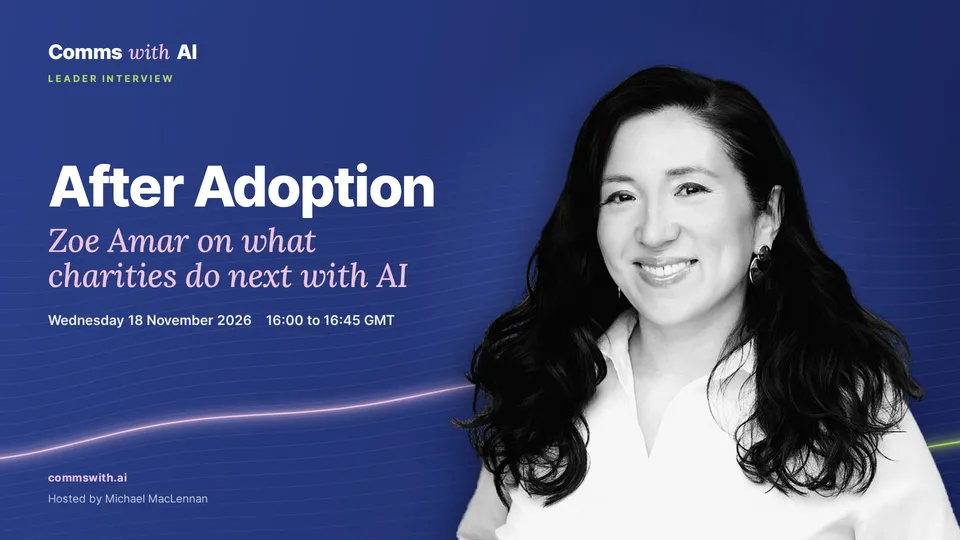
Most charities already use AI. Zoe Amar's case for what comes next starts somewhere cheaper than a new tool: leaders saying out loud how they use it, a policy built on what staff actually do, and decisions about where AI does not belong.


Zoe Amar

Zoe Amar is founder and director of Zoe Amar Digital, a social enterprise helping charities make digital and AI work better for everyone. She chairs the Charity Digital Code of Practice, co-chairs the Charity AI Task Force, co-authors the Charity Digital Skills Report and has spent 18 years on charity boards. She also co-hosts the leadership podcast Starts at the Top, which reached its 100th episode in October. We spoke on Wednesday 18 November.
The Brief
- The claim: Most organisations, charities included, have adopted AI. What they lack, Zoe said, is “this organisational lexicon or shared language of how they talk about it”, and it can start simply – with a leader saying: “hey, I used AI to do this thing, and I learned this”.
- The evidence: 79% of charities now use AI and 51% have no AI policy, according to the 2026 Charity Digital Skills Report. Her order of work (applicable to any organisation): find out how staff actually use it, write the policy from that, then coach people to live it, because “this is a step change in how we work”.
- The takeaway: Start by saying how you use AI. The policy lands better once people already talk about it.
This was a Comms With AI Leader Interview, our live series with leaders in communications and AI. The full conversation is below, with chapters, and every quote here plays from the moment it was said. Upcoming sessions are on the Comms With AI events page.
The Story
My second question was clumsy (yes, it happens, even to us self-anointed comms experts…). I asked how charities bring AI use into the open, when a year or two ago people used it quietly and didn’t say so. Zoe didn’t take the premise, taking it as the opportunity to raise a crucial point.
“I just want to very gently challenge what you’ve just said,” she began. 4:40 You can’t open the sector press or sit down with anyone without AI coming up. The quiet is inside organisations: “they’re interested in AI, they’re using AI, there’s some great innovation happening, but they don’t yet have this organisational lexicon or shared language of how they talk about it.” 5:10
She was right, and it was a better question than the one I’d asked. That kind of correction comes from the depth and breadth of her experience working and speaking with leaders and charity teams, and it set up everything that followed.
As normal as the CRM
Her fix is cheap and starts at the top (fittingly enough, given her great podcast). Someone on the leadership team says, openly, “hey, I used AI to do this thing, and I learned this, and this went well, and this didn’t go so well” – the way we’d say we pulled the data from the CRM or googled something. 5:29 ChatGPT turned four at the end of November, and AI use “still feels a bit strange”, she argued, largely because that habit is missing. 5:43
Comms teams are well placed to go first. From the report she co-authors: 60% of charities use AI for everyday tasks such as summarising notes and drafting emails, 57% to create documents, reports and presentations, 47% for research and 43% to generate ideas; at organisation level, 39% use it for social media and 36% for comms and fundraising. “Comms people are very much the early adopters,” she said, as they were when social media arrived. 3:51
Evidence first, then the policy
On policy, her order of work is worth keeping by your own side. Before you write a policy, or scale anything, “get some insight on how AI is being used” 7:32: run a survey or interviews or, in a small charity, ask people which tools they use and for what. Then design the policy around what you find, rather than around assumptions.
Try it
Before the policy: a ten-minute AI check-in
- Ask Find out which tools people use, and for what.
- Write Build the policy around what you find.
- Coach Support people to live it.
We're putting together guidance on using AI at work, and we want it to fit how you actually work. This takes about ten minutes. There are no wrong answers, and we'll share what we learn.
- Which AI tools do you use for work, including free ones on your own phone or laptop?
- What do you use them for? Name your two most common tasks.
- What has gone well, and what has gone wrong or felt uncomfortable?
- Where do you think AI could help us most, and where should we never use it?
- What would help you use it with more confidence: guidance, training, better tools or someone to ask?
The second gap comes after. “Engaging with an expenses policy, right? That’s pretty straightforward, but with AI, this is a step change in how we work.” 8:32 Even with a good policy, staff need “support and guidance and upskilling and coaching” to meet it 8:57, and done well, that’s a chance to get people excited and innovating faster. (If you’re writing or rewriting a policy, the templates in the Comms With AI governance library are a starting point you can adapt.)
The bias you can see, and the bias you can’t
Some bias is obvious. Researching guests for the podcast, Zoe asked ChatGPT for charity chief executives doing interesting work and got “essentially just wall-to-wall white men”. 12:45 (She told it there is diversity among charities, and to factor that in.)
The subtler example is the one that stayed with me. An international NGO invited her to speak overseas, with no fee and no travel costs. The AI she talked it through with encouraged her to go. She pointed out that hers is a social enterprise run by its founder, a woman of colour, and the other party a multimillion-pound organisation, and that nudging her to accept was itself a kind of bias. Earlier in her career, she said, she “probably would have sucked it up and gone along”. 14:00 That’s the case for training staff to spot the subtle version, and for telling them they’re expected to challenge it.
Decide, then say why
On ethics and sustainability, her advice is blunt: have the conversations, give someone the job of prioritising them, and then decide, or “you could just end up debating AI ethics and sustainability forever”. 18:10 A small arts charity she worked with recently said yes to AI in a stretched back office, and no to it in the songwriting classes it runs. 17:13 Both decisions follow the mission.
The same goes for telling people. Disclose where it’s proportionate: no need to flag a light edit of the newsletter, but perhaps where AI was a thinking partner on the annual report. 19:06 Ask supporters what they think before you decide. And because she’s surprised there hasn’t been more scrutiny of charities’ positions on AI yet, “start preparing some lines on it” before a major donor or journalist asks. 20:51
Behind the curtain: what my voice taught me
Her test for any copy, written by a person or with AI, is one I’ve stolen already: “if I take out the name of your charity from the copy, and I can still tell it is you, that is a sign of really good writing.” 30:40
If I take out the name of your charity from the copy, and I can still tell it is you, that is a sign of really good writing.
As it happens, I’ve been working on exactly this over the past week. I’d noticed that my own drafts were becoming too ‘beige’: tidy, hedged, and recognisably drafted rather than written. So I wrote a voice charter, a set of rules for how I sound, and then tested it the way Mike Taylor describes in his Every piece on getting AI to write like him: turn pieces I’d already published into briefs, have AI draft from them, and ask a blind judge which draft sounds more like the real thing.
My charter, used as the drafting instruction, did worse than no instruction at all. Whoops! However, a much shorter instruction, rewritten from what the judges said was wrong, beat no instruction on all six test pieces and on two of three fresh ones, with one tie. It’s better, and has already proved helpful for getting to the final product quicker, even if it still isn’t me.
It also had to learn three registers: Faur, where clients get a recommendation and decide; Comms With AI, which is plainer and warmer; and Applied, where I argue in public. That in itself felt an important reminder that it’s often not just a single tone of voice, even for a single person, and that, as ever, context is king.
Boards, bills and slop
For boards, Zoe’s ask is basic: get AI skills on the board, a gap the report has found two years running 24:00 – Reach Volunteering, rescued from closure in September, is one place to find trustees. And from her new AI guide for trustees: “please don’t put your board papers into free tools that aren’t secure.” 26:51 When she asks trustees at conferences who uses AI, plenty of hands go up; when she asks who has secure tools from their charity, “a tiny, tiny handful”. 27:07
On cost, budget for contingency, encourage people to be “purposeful and intentional and selective” 22:42, and start managing boards’ expectations, because this may be an era of cheap AI that won’t last.
And leaders should ask their teams the quality question directly: “can you take me through what your quality assurance process looks like?” 25:26 Many charities, she said, now receive documents that are obviously AI-generated and not much good. Her verdict: “there’s no point investing in tooling and training if you then find that people aren’t using the tools in the right way.” 26:24
From the room
Asked about cultural barriers, Zoe said the biggest is confidence. 32:31 Asked whether charities are open to new ways of working, she pointed to her October report with Corndel and Microsoft, What does the future of the charity workforce look like in the age of AI?, and predicted “tech on the org chart, sooner rather than later”. 35:08
An attendee who works with children asked how to balance authenticity and safeguarding in imagery. Zoe’s answer was caution, and policy: a youth charity she worked with recently is building into its AI policy that staff never upload images of children to AI tools to manipulate them. 36:34 Her counter-example was Toronto’s Furniture Bank, which used AI images for a donor campaign rather than send photographers into families’ homes, with prompts drawn from clients’ own descriptions, and said so in its name: “The picture isn’t real. The reality is.” “A really clever example of where the medium is the message.” 38:25
The Practice: what to borrow from Zoe
- Go first, out loud. At your next team meeting, say one thing you used AI for this week, what worked and what didn’t. Then ask your team the same question, and write down the answers: that’s the evidence your policy needs.
- Decide where AI doesn’t belong, and write the line. Pick one area where your organisation won’t use AI and say why, in a sentence a supporter would accept. Then draft the two lines you’d give a journalist or a major donor who asks how you use it.
- Run the name test. Take your organisation’s name out of your last three pieces of copy. If you can’t tell they’re yours, the problem is your voice, whoever drafted them.
“Keep talking about how you’re using AI,” she said, when I asked for one change a charity comms lead could make in the next month. 28:07 So, what’s the one thing you’d say first?
Every Applied piece follows the same shape (The Brief, The Story, The Practice) and is made the same way: my argument and examples, drafted with Claude, every claim checked against its source, and a final edit by me.
Coming up: the Comms With AI Roundtables, The Year in Review on Wednesday 9 December and The Year Ahead on Wednesday 13 January 2027, both 12:00 to 13:00 GMT.
44 claims checked against their sources.
More like this
interviewGovern
Not a dirty word: Billy Partridge on making it safe to say no to AIThe last Leader Interview, on deciding where AI stops and making it safe to say no.
interviewGovern
The honesty gap: Ben Verinder on AI, PR and trustTrust and honesty, for Zoe's point on telling supporters how you use AI.
guideGovern
How to introduce AI into an in-house comms team: a starter guide for Q4 2026A starter guide for the team behind the policy: what to try first, and what to keep out of free tools.