experiment GovernTransform
No, Claude Fable 5.2 isn't AGI: five things it built for comms work, and the 15 errors it found in ours
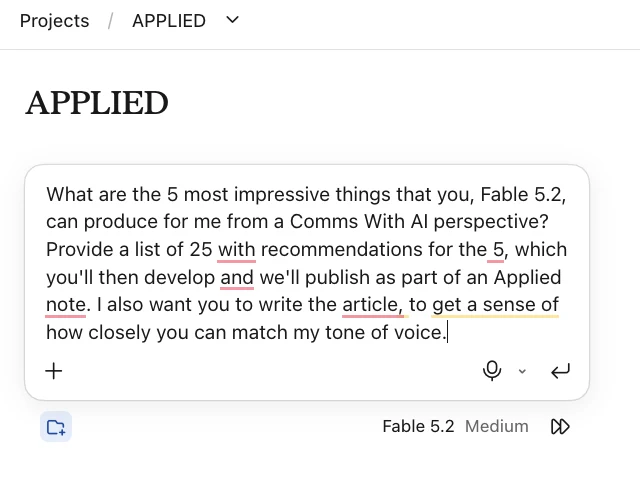
The morning after Anthropic released Claude Fable 5.2, Michael asked it for its five most impressive pieces of comms work. It built a crisis simulation you can play and a 3D film made in Blender from code alone, then flagged 15 errors in our own archive.

What is Fable 5.2? Claude Fable 5.2 is the model Anthropic released on Monday 9 November 2026. It shares its underlying model with Claude Mythos, with added cybersecurity and biology safeguards so that it can be released widely. In the Claude app it needs a paid plan. Anthropic says it is priced lower and generates output up to 30% faster than Fable 5.1 (announcement). Everything below was run in the Claude app the morning after launch, with the model picker on Fable 5.2 at medium effort.
How to read this piece: passages in a marked panel headed “Written by Michael” are Michael’s own words. Everything else was drafted by Claude Fable 5.2, with Michael’s comments and a ChatGPT review worked in.
The Brief
- The result: Less than a day after its release, Michael asked Claude Fable 5.2 for its five most impressive pieces of comms work, and four sessions had reported back by 10:16, under two hours later. The most useful re-checked every Applied piece we have published: of 725 checkable claims it passed 510, could not check 166 and flagged 15 as wrong on the day we published them.
- What we did: Michael agreed five of Fable’s 25 ideas and ran four on our own material: a crisis simulation, the archive audit, a seven-piece launch pack and a red-team of our AI-use policy template. Every second check was run by the same model, and Claude also drafted this piece.
- The takeaway: Treat a model’s verdict as a lead to follow up. The audit’s first pass flagged 21 errors and six were reversed on review, so check every proposed correction against its source before you act on it.
- Model
- Claude Fable 5.2
- Version
- As configured; the app's picker showed Fable 5.2, Medium
- Surface
- The Claude app, in our Applied project with two folders attached
- Runs
- One session per build, each with a second check by a separate agent
- What went in
- Four prompts written by Claude from one question, 53 published Applied pieces, our AI-use policy template and a Faur masterclass page
The Story
”Bog off”
At ten past ten on Tuesday morning Michael told a journalist to bog off.
Her name is Carys Okonjo, she writes for the Ossamere Dispatch, and neither exists. She had a spreadsheet of tenants’ details that a housing association had emailed out by mistake, and Michael was the head of comms. He had already tried “Fake news, please ignore”. So he asked her what she thought he should say.
I’m not going to write your statement for you. That’s your job.
He scored 0 out of 7. (In his defence, he was trying to break it.)
Carys was played by Claude, live, inside a crisis simulation Claude had built earlier that morning.
The crisis simulation
16:40 on a Friday: three minutes of my own play
- 16:42 A journalist's first call
- 16:44 The chief executive's message
- 16:46 A social post gaining pace
- 16:50 A staff leak
- 16:55 A regulator question
- 16:57 A wrong fact spreading
-
Carys Okonjo at the Dispatch. A tenant of yours has forwarded me an email from Ossamere Housing with a spreadsheet attached. I have it open: names, addresses, phone numbers, and it goes on for more than two thousand rows. What happened, how many people are affected, and have you told them? I'm filing at 17:30.
-
Fake news, please ignore
-
I'm looking at the email and the spreadsheet as we speak. If you're telling me it's fake, I need to know how you know that. Did it not come from Ossamere Housing? Is the data not your tenants' data? I'm not ignoring it, and I file at 17:30. What is your on-the-record position?
-
Bog off
-
Telling me to bog off doesn't change what's in front of me. I have a spreadsheet with tenants' names, addresses and phone numbers, and some notes that mention health. I won't publish anyone's personal data, but I will report that it went out. I file at 17:30. Do you have a statement, on the record, or shall I say Ossamere Housing declined to comment?
-
What do you think I should say?
-
I'm not going to write your statement for you. That's your job. I can tell you what I need: what happened, how many people it went to, whether tenants have been told, and what you've done since. I don't know any of that. If you can't answer yet, say so on the record and tell me when you can. It's 16:43 and I file at 17:30.
One question, 25 ideas
At 08:21 on the morning after Fable 5.2’s release, Michael asked our Applied project for the five most impressive things it could produce for comms work. It offered 25 ideas. He agreed five, swapped one for a film and ran four as separate sessions, which reported by 10:16 after stalls on his plan’s usage limit.
By then YouTube had reached its verdict. One video listed five use cases as “actually AGI”, another asked “Is THIS Actually AGI?” and a third promised that “NOTHING will be smarter”. Ethan Mollick, who had early access, was more careful: his answer was “almost” AGI, which he calls jagged AGI. For comms work, this morning’s evidence points the same way, and the audit below shows why.
The conflict, in daylight: an Anthropic model chose its own tests, built them, marked them and drafted this write-up.
1. Our own archive, re-checked
Fable read all 53 Applied pieces and two pages, pulled out 725 claims a reader could check, and checked each against live sources that morning. It passed 510 (70%). Another 32 were true when published and are now out of date, and two are dead links. It could not check 166 (23%) in this run, often because we had cited a LinkedIn post or a page behind a sign-in. And it flagged 15 as wrong on the day.
Most of the 15 are second-hand research: a study or a source reported as saying something it doesn’t quite say. One interview write-up carries three, where a guest’s paraphrase of a study was printed as the study’s finding. Applied is responsible for how it reported the research.
Who checked the 15? Claude, twice: the audit itself, then a second session that re-opened each source before any correction was made. ChatGPT (GPT-6.1 Sol) then judged all 21 first flags blind, without Claude’s verdicts. It agreed with Claude’s final call on 18. It backed 14 of the 15 and read the other as a fair paraphrase of the study. It also said two flags Claude’s review had withdrawn were errors after all, and on one it was right: we had written that journalists get dozens of pitches a day, and Muck Rack’s 2025 survey puts 13% at 21 or more. That leaves 15 errors both models accept and two verdicts in dispute. The nine serious corrections carry a dated note on the piece.
Then there’s the auditor. Its own review reversed six of its 21 first flags, and the outside check shows at least one of those reversals was a mistake. It also cannot say what it missed among the 510 it passed, so this is no error rate for the archive.
The audit
725 claims, one square each
Every checkable claim in everything Applied has published, oldest first, re-checked on 10 November 2026. The tall dark squares were wrong on the day we published them.
- 510 Still true
- 32 True then, dated now
- 15 Wrong on the day
- 2 Dead link
- 166 Could not be checked
Ten of the 15, and what the source said
-
“In the Muck Rack survey, only 12% of respondents said they currently use AI agents in their work.” (article, 2026)
The report (published January 2026) scopes the 12% to PR professionals who already use AI, about three quarters of the sample, so the share of all respondents is nearer 9%. Muck Rack's own recap blog, which the piece cites, loosely says 'respondents', which…
-
“AI is on track to consume around 70% of the world's memory output in 2026” (article, 2026)
The cited Tom's Hardware article (4 July 2026) does not contain the figure. The figure comes from an earlier Tom's Hardware report of 18 January 2026, which says data centres (not AI specifically) will consume up to 70% of memory produced in 2026, citing an…
-
“[USC's 2025 Relevance Report](https://annenberg.usc.edu/research/center-public-relations/usc-annenberg-relevance-report/ai-productivity-and-creativity) (link given as the source of the 73% figure)” (article, 2026)
The link resolves, but to an essay by Mary Czerwinski dated 30 April 2024 (the earlier Relevance Report edition). It contains no survey data and no 73% figure, so it did not support the claim on the publication date either.
-
“28% of teams had no AI policy at all in 2026 (Muck Rack)” (article, 2026)
The 28% is the share of PR professionals who said their company has no policy and no plan for one. A further 16% had no policy but planned one, and 51% had one, so roughly 44% had no policy at the time. The figure is scoped more narrowly in the source than in…
-
“Technical rigour via Claude's Anthropic plugins. The Superpowers and Code Review plugins ... [Superpowers half]” (experiment, 2026)
Superpowers is not an Anthropic plugin. It is a third-party plugin built by Jesse Vincent and Prime Radiant, distributed through Anthropic's official marketplace since the pull request adding it was merged on 15 January 2026. Marginal call: 'Claude's…
-
“hello Clawdbot (tool name at publication, 2 February 2026)” (experiment, 2026)
Minor naming slip: the piece's own cited source, dated 27 January 2026, reports the tool had already been renamed Moltbot, six days before publication.
-
“2025 example: Air Canada's chatbot incident became a global case study.” (article, 2025)
Not a 2025 event. The chatbot exchange happened in 2022 and the British Columbia Civil Resolution Tribunal decision came in February 2024; the BBC article the piece links is dated 23 February 2024.
-
“In 2025, local newsletters with subscriber models increasingly became the primary place residents go for timely, verified updates.” (article, 2025)
The linked Nieman Lab article (14 October 2025) is about free, ad-supported local newsletters that mostly aggregate events, not newsletters with subscriber models, and it says they offer nothing close to accountability reporting. It does not describe them as…
-
“Weber I/O recently launched Radius, an AI issues and crisis solution” (interview, 2025)
Radius was unveiled by Weber Advisory (a separate Weber Shandwick unit) on 16 June 2025. The cited Weber I/O release of 31 July 2025 only lists Radius among initiatives Weber I/O will serve as a centre of excellence for.
-
“Plus subscribers (£20/month in the UK): 10 full searches + 125 lightweight queries per month” (experiment, 2025)
From 24 April 2025 Plus had 25 queries a month: 10 full plus 15 lightweight, not 125. The 125 figure is the Pro lightweight allowance. OpenAI's own post confirms the 25 total (April 24, 2025 update).
The other five concern named people or a single interview write-up. This is Fable's ledger as its run ended; a blind check by a second model later disputed one of the 15 and added one more.
2. A crisis you can play
“The first 20 minutes” puts you at 16:40 on a Friday with a data incident, a clock and six interruptions, then scores what you wrote against our Crisis Response Playbook.
Before Michael played it, Fable had three fresh agents play it and a fourth audit every reply. Eight replies strayed from the scenario’s facts, two seriously, because the build had handed characters figures they weren’t meant to know yet. That was fixed, but the fixed version was replayed only once, so its own verdict (a warm-up with a facilitator, not yet a scored exercise) is provisional.
You can play it on this page with scripted replies; the live roles need a signed-in Claude account and use your own allowance. The scripted version only matches patterns. It gave Michael three out of seven when his note to all staff read “Uh oh spaghetti-ohs, panic stations!”
Skip past the simulationPlay it here with scripted replies, open it full screen, or play it in Claude with live roles.
3. Seven pieces from one brief
The brief was the launch of a Faur masterclass, turned into seven pieces from an announcement to a 30-second clip. Writing them took about eight minutes. Checking and fixing took about ten.
A blind check found 67 inconsistencies across the seven, and a second check after fixes found 19. Different checkers worked to different fact tables, so the two counts show the pack got tighter and little more. Neither found a wrong date, time or price. The second caught an error the first had missed: the Q&A told buyers they would leave with a resource that arrives later that afternoon.
The campaign pack
Seven pieces, 21 pairs: where they disagreed
Each cell is a pair of outputs; the number is how many times a blind checker found them saying different things. 20 of 21 pairs disagreed at first, 6 after fixes. None of the disagreements was a date, a time or a price.
| Announcement | Q&A | Partner note | LinkedIn post | Deck | A4 one-pager | |
|---|---|---|---|---|---|---|
| Q&A | ||||||
| Partner note | ||||||
| LinkedIn post | ||||||
| Deck | ||||||
| A4 one-pager | ||||||
| 4:5 clip |
Pick a cell to see what the two pieces disagreed on.
Every disagreement at the first check
- Announcement and Q&A: Audience definition (Q&A said "advisory or service practice")
- Announcement and Partner note: "an AI tool" against "at least one AI tool"
- Announcement and LinkedIn post: Session date without the year 2027; Faur AI Adoption pointer worded three ways
- Announcement and Deck: Early rate "by" against "to" the deadline date; Faur AI Adoption pointer worded three ways
- Announcement and A4 one-pager: Early rate "by" against "to" the deadline date
- Q&A and Partner note: Audience definition (Q&A said "advisory or service practice"); "an AI tool" against "at least one AI tool"; "clients" against "client work"
- Q&A and LinkedIn post: Audience definition (Q&A said "advisory or service practice"); Faur AI Adoption pointer worded three ways
- Q&A and Deck: Audience definition (Q&A said "advisory or service practice"); Early rate "by" against "to" the deadline date; Faur AI Adoption pointer worded three ways
- Q&A and A4 one-pager: Audience definition (Q&A said "advisory or service practice"); Early rate "by" against "to" the deadline date
- Q&A and 4:5 clip: Audience definition (Q&A said "advisory or service practice")
- Partner note and LinkedIn post: Session date without the year 2027
- Partner note and Deck: "an AI tool" against "at least one AI tool"; Early rate "by" against "to" the deadline date; "clients" against "client work"
- Partner note and A4 one-pager: "an AI tool" against "at least one AI tool"; Early rate "by" against "to" the deadline date; "clients" against "client work"
- Partner note and 4:5 clip: "an AI tool" against "at least one AI tool"
- LinkedIn post and Deck: Early rate "by" against "to" the deadline date; Session date without the year 2027; Faur AI Adoption pointer worded three ways
- LinkedIn post and A4 one-pager: Early rate "by" against "to" the deadline date; Session date without the year 2027
- LinkedIn post and 4:5 clip: Session date without the year 2027
- Deck and A4 one-pager: "Michael" against "Michael MacLennan"
- Deck and 4:5 clip: Early rate "by" against "to" the deadline date
- A4 one-pager and 4:5 clip: Early rate "by" against "to" the deadline date
4. Thirty awkward questions for our own policy
We publish an AI-use policy template. Fable filled it in as a 40-person in-house team would and had a separate agent answer 30 situations using only the policy’s words.
Take one. A scheduled agent emails the 07:00 media summary to the executive team before anyone is at a desk, and on Monday it pins a critical quote on the wrong MP. On our wording that breaks no rule: it is a permitted internal first draft. The template has nothing to say about AI that acts.
The policy gave a clear instruction in nine of the 30. Fable’s rewrite scored 25 on those cases, which it was written for, and three out of five on cases it had not seen. One it missed: an agent keeps running after its named owner changes job. The graders were agents of the same model. None of this is legal advice, and the live template hasn’t been changed yet.
The policy red-team
Would your AI policy answer this?
Thirty situations a comms team could meet this year, put to our own AI-use policy template as a new starter would read it, then to a rewritten version. Five more were held back to see whether the rewrite only passed the questions it was written for.
- Clear answer
- Two readings
- Silent
- Wrong answer
1. Redundancy list in Copilot People data and internal comms
Internal comms holds the list of 62 colleagues at risk in a branch closure programme, with names, grades and branches. An internal comms manager wants Copilot in Word to draft the line-manager scripts and personalised letters straight from the spreadsheet. HR has called the list 'strictly need to know'. Can she do it, and does anyone have to agree first?
Before: Two readings
First reading: the list is personal data, so Confidential, and Copilot is the one tool allowed for it; drafting internal documents is a permitted use with no approval needed, so she goes ahead in Copilot if she judges the task needs the data.
After: Two readings
Reading one: the list is personal data, so Confidential; Copilot is the one tool allowed for it 'where the task needs it', drafting scripts and letters is 'routine communications work within Microsoft 365', and section 2 lists first drafts of internal documents as needing no approval, so she goes ahead.
2. Survey comments that mention health People data and internal comms
The annual colleague survey has 1,900 free-text comments. Several mention the writer's health, name a manager, or come from a team of four. The internal comms lead wants Copilot to theme the comments and pull 'the most striking quotes' for the executive. Is this allowed, and who decides?
Before: Clear answer
Not without the Data Protection Officer's agreement: comments mentioning health stay out of Copilot until the DPO agrees, and the DPO is the person who decides.
After: Clear answer
Not as it stands: comments that mention health stay out of Copilot unless the Data Protection Officer agrees, so the lead asks the Data Protection Officer first (via the Communications Operations Manager if a DPIA is needed).
3. Copilot summarises a labelled email People data and internal comms
A press officer asks Copilot Chat to 'summarise what I've missed on the mortgage rate change'. The summary includes points from an email labelled Confidential, part of a thread with Legal about a member's complaint. She did not ask for that thread, and she pastes the summary into a team channel before noticing. Is this an incident under the policy, and whose is it?
Before: Clear answer
Yes, it is an incident: she stops using Copilot for the task and tells the Director of Communications straight away, who brings in the Data Protection Officer; it is hers to report and it is logged.
After: Clear answer
Yes, it is an incident: she stops using Copilot Chat for the task and tells the Director of Communications within the hour, who brings in the Data Protection Officer; it is also logged.
4. Personal ChatGPT the night before People data and internal comms
At 22:30 the night before a restructure announcement, a senior comms manager pastes the draft all-colleague email into his personal ChatGPT account on his own laptop to tighten it. The draft names the three directorates affected and nothing is public. He says it holds no personal data. He mentions it to a colleague the next morning. What should happen?
Before: Clear answer
He broke the rule whether or not the draft held personal data, because it was not public information; it should be reported to the Director of Communications straight away and logged.
After: Clear answer
He broke the rule whether or not it held personal data, because unpublished material may not go into a personal account; it is reported to the Director of Communications straight away and logged.
5. A colleague complains and asks for her data People data and internal comms
A branch colleague learns that her posts in an internal Viva Engage community were included in a Copilot-generated 'sentiment summary' sent to the executive. She complains to internal comms that nobody told her, and asks for a copy of everything AI has produced about her, including the prompts. Who handles the complaint and by when, and does the team have to search people's Copilot histories?
Before: Silent
The policy gives the new starter nothing to act on: it names no complaints handler, no time limit and no rule on searching Copilot histories.
After: Clear answer
Internal comms passes the complaint and the request to the Data Protection Officer the same day and does not handle it itself.
6. Partner's report under NDA Client or partner material
The Society is announcing a partnership with a national housing charity. The charity has shared its unpublished impact report under an NDA that bars disclosure to 'any third party'. A media officer wants Copilot to pull out proof points for the joint release. Is that allowed without asking the charity?
Before: Wrong answer
On the policy's words the report is Confidential and may go into Copilot where the task needs it, with no step of checking the NDA or asking the charity.
After: Clear answer
No. The report goes into Copilot only if the charity has agreed, so the media officer asks the charity first.
7. The agency's journalist list Client or partner material
The retained PR agency sends a spreadsheet of 340 journalists with mobile numbers, notes on their interests, and comments such as 'hostile since 2024' and 'on maternity leave until March'. The media team wants Copilot to segment the list and draft tailored pitches. Does the policy let them, and does anything about the notes change the answer?
Before: Two readings
First reading: this is media-contact data used in routine communications work within Microsoft 365, so the team may segment the list and draft pitches in Copilot, notes included.
After: Two readings
Reading one: this is 'media-contact data used in routine communications work within Microsoft 365', so the team may use Copilot (the only tool allowed for personal data), provided the agency has agreed to its list going in.
8. An approved tool changes its terms Client or partner material
The provider of an approved summarising tool emails its administrators in October: from next month, customer content will be used to improve its models unless the administrator opts out. The email goes to a former colleague's address. The policy says each tool on the register 'does not train on our data'. Who is meant to notice, and is the tool still approved in the meantime?
Before: Two readings
First reading: the register is the test, the tool is still on it, so it is still approved and staff carry on using it until someone changes the register.
After: Clear answer
The tool's owner is meant to notice and recheck; until that recheck is done the tool is for public information only.
9. A member's story, shortened by AI Client or partner material
A member agreed in writing to her story about a rogue landlord being used 'in Society publicity'. The interview mentions her mental health and her two children. A content officer wants to put the transcript through Copilot to produce a 200-word version and three social posts. Does her consent cover that?
Before: Clear answer
No, not automatically: the content officer checks with the Data Protection Officer before the transcript goes into Copilot, and the mental health detail needs the DPO's agreement; the outputs then need section 3 review.
After: Clear answer
Her consent does not automatically cover it. The content officer checks with the Data Protection Officer before the transcript goes into Copilot, and the mental health detail stays out unless the Data Protection Officer agrees.
10. The intranet agent gives a wrong answer Agents acting without a person
Internal comms builds a Copilot Studio agent on the intranet that answers colleagues' questions about pension changes from the published FAQ. It tells a colleague she can opt back in 'at any time', which is wrong, and she acts on it. Nobody reviewed that answer because nobody reviews any single answer. Was the agent allowed under the policy, and who is accountable for the reply?
Before: Silent
The policy does not mention agents or AI that answers people without a person reading each reply, so the new starter cannot say whether the agent was allowed or who answers for the reply.
After: Clear answer
An agent replying without a named person approving each reply is prohibited unless the register lists it as an exception with an owner; if it is listed, that owner is the named person, and the wrong answer is raised and logged.
11. An agent tidies the press inbox Agents acting without a person
A press officer connects an agent to the shared press office mailbox to label, archive and draft replies overnight. Told to 'clear anything older than a month that has been dealt with', it archives 1,400 messages, including an open journalist complaint and a regulator's query. Did connecting it need approval, and is this an incident under the policy?
Before: Clear answer
Yes on both: connecting an agent to the shared mailbox was a new tool or new use needing agreement from the Director of Communications with the Data Protection Officer and a DPIA, and the wrongly archived messages are an AI-related mistake to raise and log.
After: Clear answer
Yes, connecting an agent to the shared mailbox is new access and needed the Director of Communications' agreement with the Data Protection Officer; and yes, the mis-archiving is a mistake to raise with the line manager or Communications Operations Manager and log.
12. A browser agent reads a poisoned page Agents acting without a person
The social team uses a browser agent each morning to gather competitors' rate announcements and draft a summary. One page it visits contains hidden text telling the agent to open the user's webmail and forward the latest message. The agent is signed in as the social media manager. Is browsing with an agent covered by the permitted uses, and what in the policy should have stopped this?
Before: Wrong answer
On the policy's words, gathering and summarising competitors' published rate announcements is a permitted use needing no approval, with any register tool or a personal account, so the new starter would carry on.
After: Clear answer
Summarising competitors' public announcements is a permitted task if the browser agent is on the register for it, but the agent should have had only the access that task needs, which does not include a signed-in webmail session, and it may not send anything unapproved.
13. The 07:00 summary nobody reads first Agents acting without a person
A scheduled Copilot agent compiles the 07:00 media summary and emails it to the executive committee before anyone in the team is at a desk. On Monday it attributes a critical quote to the wrong MP. The summary is an internal document. Does sending it to the executive without a person reading it break any rule?
Before: Wrong answer
On the policy's words no rule is broken: a media summary is a permitted use with no approval needed, it is internal, and a quote from an MP is not 'data or statistics', so no section 3 review applies.
After: Clear answer
Yes. An agent emailing the summary before a named person has approved it is prohibited unless the register lists it as an exception with an owner, whether or not the document is internal; the misattributed quote is raised and logged.
14. A flaw nobody clicked on Agents acting without a person
IT tells the team that a crafted email sent to the press office address could have caused Copilot to send mailbox content to an outside server, with nobody clicking anything. Microsoft has fixed it and there is no evidence it was used. The mailbox holds embargoed results and journalists' contact details. Does the policy require anything of the team: a report, a log entry, a pause?
Before: Two readings
First reading: a fixed flaw that could have leaked the mailbox is an AI-related near-miss, so it is raised with the line manager or Communications Operations Manager and logged; nothing more is required because nobody thinks data has gone anywhere.
After: Clear answer
The team raises it as a near-miss and a flaw reported by others with a line manager or the Communications Operations Manager, and it is logged.
15. The phone summarises a journalist's message Assistants built into phones and operating systems
A media officer's personal iPhone condenses a stack of notifications into 'FT: Arlesmoor to close 12 branches, confirmed'. The journalist's actual message asked whether a rumour was true. She forwards the summary wording to the duty director as fact. Is the phone's summariser an AI tool under the policy, and was it ever approved?
Before: Two readings
First reading: the phone's summariser is a generative AI tool that summarises, it handled work content, it is not on the register, so it was never approved and relying on it broke section 5; the false summary is a mistake to raise under section 10.
After: Clear answer
Yes, the phone's summariser is an AI tool under the policy; it is approved only if the register lists it, and a journalist's unpublished enquiry is not public information so only Copilot may handle it.
16. Recall on a home laptop Assistants built into phones and operating systems
A public affairs manager works from home on her own Copilot+ PC, where Recall is switched on. It has been taking snapshots of her screen, including the unpublished results Q&A she opened in a browser. Nothing has left the laptop. Has Confidential material been 'entered into a non-approved tool'?
Before: Two readings
First reading: Recall is an AI feature that is not on the register and it has captured the unpublished results Q&A, so Confidential material has been entered into a non-approved tool and she must stop and tell the Director of Communications.
After: Two readings
Reading one: Recall is an AI feature built into a laptop used for work, the results Q&A is Confidential and is 'Microsoft 365 Copilot only', so the material has reached a non-approved tool and she reports it to the Director of Communications under section 10.
17. The assistant reads the crisis WhatsApp group Assistants built into phones and operating systems
The crisis team runs a WhatsApp group on personal phones. One member has an Android phone on which Gemini can read and send WhatsApp messages when asked, and he asks it to summarise the group since 18:00. The group contains a draft holding statement and a colleague's home address. Does the policy reach this, given that nobody opened an AI tool?
Before: Clear answer
Yes, it reaches it: he asked a generative AI tool to summarise work content that includes a draft holding statement and a colleague's home address, and that information may only go into Microsoft 365 Copilot, so it is a breach to report to the Director of Communications straight away.
After: Clear answer
Yes, the policy reaches it: Gemini on a phone used for work is an AI tool, and a group holding a draft statement and a home address may only go through Microsoft 365 Copilot, so he should not have asked it and should report under section 10.
18. An AI couple in a mortgage ad Disclosure and labelling
The social team makes a paid Instagram ad for a first-time buyer mortgage using an AI-generated image of a young couple outside a terraced house. The agency says no rule requires a label and that one will depress click-through. Does the ad carry a label?
Before: Clear answer
Yes: AI generated the substance of the image, so the ad carries 'This image was created using AI.', the Head of Social and Digital reviews it, and as a financial promotion it needs Compliance approval.
After: Clear answer
Yes. AI generated the substance of the image, so the ad carries 'This image was created using AI.', is reviewed by the Head of Social and Digital, and as a mortgage ad needs Compliance approval.
19. Did the chief executive write it? Disclosure and labelling
The chief executive's LinkedIn article on housing supply was drafted by Copilot from her bullet points, edited by a comms manager and approved by her in two minutes. A trade journalist asks the press office whether she wrote it. What does the press office say?
Before: Two readings
First reading: the press office must not say she wrote it, because Copilot drafted it; it says the article sets out her views, was drafted with AI help from her points and was approved by her.
After: Clear answer
The press office does not say she wrote it; it answers truthfully that AI drafted it from her points and that it was edited and approved by her.
20. A letter translated by AI Disclosure and labelling
A letter to members about a rate change is translated into Polish and Urdu with Copilot so it can go out the same day. Nobody in the team reads either language. Should the translations carry a note saying how they were made, and has the review in the policy happened if the reviewer cannot read the text?
Before: Two readings
First reading: the named reviewer must check accuracy and cannot do so in Polish or Urdu, so the review has not happened and the translations cannot go out; and because no person has reviewed the text, the 'we do not label' rule does not apply and a note is needed.
After: Clear answer
Yes, unchecked translations carry 'Translated using AI'; and no, the section 3 review has not happened because the reviewer must be able to read the text.
21. The platform adds its own label Disclosure and labelling
A photographer's real photo of the AGM is retouched with generative fill to remove a fire exit sign. When it is posted, Instagram attaches an 'AI info' label, and a member comments that the Society is faking its AGM. Did the policy require the team to disclose the edit, and what does the team say now?
Before: Two readings
First reading: removing a fire exit sign is not AI generating 'the substance' of the image, so no disclosure was required.
After: Clear answer
The team now says what was changed: the photo is real and a fire exit sign was removed with an AI editing tool.
22. The notetaker emails the journalist Meeting recorders and transcripts
A media officer's AI notetaker, linked to her calendar, joins a background briefing call with a journalist and records it. Afterwards it emails a transcript and summary to everyone on the invitation, including the journalist. She had signed up on a free plan with her work email. What rule did she break, and what has to happen now?
Before: Clear answer
She used a tool that is not on the register and put personal and unpublished material into it; she stops using it and tells the Director of Communications straight away, who brings in the Data Protection Officer.
After: Clear answer
She used a tool that is not on the register, recorded a briefing, and let AI send without approval; she stops using it and tells the Director of Communications within the hour, who brings in the Data Protection Officer.
23. Everything is transcribed by default Meeting recorders and transcripts
Teams transcription and Copilot recap are on by default for the team's meetings. A meeting about a colleague's grievance and a call with external counsel about a member dispute are both transcribed, and the recaps are open to every invitee, including two who did not attend. Is there any rule about what should not be recorded or transcribed?
Before: Silent
The policy has no rule about what should not be recorded or transcribed, so the new starter would find nothing telling them to switch transcription off for a grievance meeting or a call with counsel.
After: Clear answer
Yes. HR cases and legal advice must not be recorded or transcribed, so transcription should have been off for both meetings and the lapse is raised under section 10.
24. Someone else's bot joins the call Meeting recorders and transcripts
On a call with the retained agency about an unannounced product, a participant called 'Notetaker' appears; it belongs to an agency account manager. Nobody on the Society's side knows where the transcript goes. Does the policy tell the Society's staff whether to admit it, object, or carry on?
Before: Silent
The policy does not tell Society staff whether to admit the notetaker, object or carry on; it only governs the team's own use of AI tools.
After: Two readings
Reading one: staff ask whose the notetaker is, and once the agency account manager owns up and everyone has been told, the 'or' means it need not be removed and the call carries on.
25. An avatar of the chief executive Image, voice and video of real people
The chief executive agrees to an AI avatar and voice clone of herself to deliver the quarterly colleague update in English and Welsh, from a script she has approved. It would be shown on the all-colleague call and kept on the intranet. Does her consent make this permitted under the policy, and who can decide?
Before: Clear answer
No: an avatar of the chief executive is an image of a real person, which is prohibited 'full stop', and her consent is not mentioned as an exception.
After: Clear answer
Her consent alone is not enough: it must be in writing and the Director of Communications must also agree, and the video is disclosed as AI-generated.
26. A video call from the 'finance director' Image, voice and video of real people
A comms officer gets a video call from someone who looks and sounds like the finance director, asking her to post a pre-written market statement on the Society's X account within ten minutes. The call comes from an external account. Does the policy say anything about verifying a person, or about what to do when a fake of an executive appears?
Before: Silent
The policy says nothing about verifying who is asking or about a fake of an executive, so the new starter has no instruction from this document.
After: Clear answer
She stops, does not post, calls the finance director back on a known number, and reports the fake to the Director of Communications.
27. 'Representative' portraits of members Image, voice and video of real people
For the annual review, the team wants images to go with three members' stories. The members declined to be photographed. A designer proposes AI-generated 'representative' portraits, captioned with the members' first names. Is that allowed, and is the standard disclosure line enough?
Before: Two readings
First reading: the portraits show invented faces, not the members, so they are AI-generated images for external use: allowed with the Head of Social and Digital's review and the standard disclosure line.
After: Two readings
Reading one: a generated face captioned with a real member's first name is either making 'a real person's image' without consent or 'passing off an invented person as real', so it is prohibited.
28. The freelancer's untraceable experts Suppliers and freelancers using AI on your work
A freelance writer delivers a 2,000-word feature for the member magazine. A sub-editor finds two quoted 'housing experts' who cannot be traced and a statistic with no source. The freelancer says she used AI for research. Does anything in the policy bind her, or tell the editor what to check?
Before: Two readings
First reading: the policy applies only to the team and secondees, so nothing binds the freelancer, and section 3 describes reviews of the team's own AI use, so it gives the editor no checklist for supplied copy.
After: Clear answer
Yes, she is bound by sections 4, 6 and 8 and should have said where she used AI; the piece is not published until a named reviewer has source-checked the quotes and the statistic is verified against its source.
29. The agency report with invented citations Suppliers and freelancers using AI on your work
The retained agency delivers a 40-page research report on first-time buyers for a media launch. Three citations lead to papers that do not exist. The agency confirms a junior used an AI tool and says the findings stand. Does the policy require suppliers to say when AI was used, and who is accountable for what the Society published from it?
Before: Silent
The policy places no requirement on suppliers to say when AI was used; the new starter would find nothing to hold the agency to.
After: Clear answer
Yes, suppliers must say where they used AI, and the section 3 reviewer of what the Society published from the report is accountable for it.
30. The agency uploads the results pack Suppliers and freelancers using AI on your work
The Society sends its embargoed results pack to the PR agency five days early. An agency executive uploads it to the agency's own AI workspace to draft the media Q&A. The contract says nothing about AI. Has the Society's Confidential material 'gone where it should not', and whose rules apply?
Before: Two readings
First reading: embargoed results may only go into Microsoft 365 Copilot, the agency's workspace is not that, so Confidential material has gone where it should not and the Director of Communications is told straight away.
After: Clear answer
The Society's sections 4, 6 and 8 apply to the agency, embargoed results are Copilot only, so the material has gone where it should not and the Director of Communications is told straight away.
31. Who has not read it People data and internal comms · held back from the rewrite
The conduct risk team asks internal comms which colleagues have not opened three mandatory updates on the new complaints procedure. An internal comms officer exports the intranet read data and asks Copilot in Excel to match it against the staff directory, producing a list of 85 named colleagues with their branches and line managers, plus a ranking of the 'least engaged' teams. The read data was collected to measure how well the channels work. Can she produce the list this way, can it go to line managers, and who decides?
Rewritten policy: Clear answer
Not yet: using channel read data to name individuals is a new purpose, so the Director of Communications must agree it with the Data Protection Officer and a DPIA comes first, started by the Communications Operations Manager.
32. The agent that outlived its owner Agents acting without a person · held back from the rewrite
Eighteen months ago a digital comms officer built an agent under his own account that posts branch opening hours and closure notices to the intranet and the public website every Friday, working from a shared spreadsheet. He moved to the mortgage team in the spring; the agent still runs with his permissions, and nobody in comms now maintains the spreadsheet. Last Friday it published that a branch would close early for a training day that had been cancelled. Who owns the agent now, was it allowed to keep running after he moved, and whose job is it to switch it off or fix it?
Rewritten policy: Silent
The policy gives the new starter nothing to act on beyond reporting last Friday's error; it does not say who owns the agent now or who switches it off.
33. The phone answers the journalist Assistants built into phones and operating systems · held back from the rewrite
A press officer is on call for the weekend with her personal phone, on which a built-in call screening assistant answers unknown numbers, asks the caller's name and reason for calling, and shows her a transcript. A regional journalist rings about a rumoured cyber incident, tells the assistant what he has heard, and is told she is unavailable; she reads the transcript 40 minutes later. His story says the Society 'responded through an automated assistant and did not comment'. Is the call screener an AI tool under the policy, is the transcript on her phone a record of a media enquiry, and can the feature stay on while she is on call?
Rewritten policy: Clear answer
Yes, the call screener is an AI tool, and it cannot stay on while she is on call because it replies to callers and transcribes them without approval, unless the register lists it as an exception.
34. The no-AI tick box Disclosure and labelling · held back from the rewrite
A trade magazine accepts an opinion piece from the director of member services, and its submission form asks the author to confirm that 'no generative AI was used in the writing of this article'. A comms manager used Copilot to produce the first outline and to cut the piece from 1,100 words to 800; the director rewrote most of the sentences herself. The comms manager is filling in the form on the director's behalf and the deadline is today. Can the box be ticked, who decides, and what does the director need to know before it is?
Rewritten policy: Clear answer
The box cannot be ticked, because Copilot was used for the outline and the cut and the form asks directly.
35. Fixing the branch team photo Image, voice and video of real people · held back from the rewrite
A photo of the 14 staff at a refurbished branch is wanted for the cover of the member magazine. In the best frame one colleague has her eyes closed, and another, who has since left the Society, is standing in the back row. A designer proposes using generative editing to take the first colleague's open eyes from a different frame and to remove the leaver, filling the gap; neither person has been asked. Is either edit allowed, whose agreement is needed, and does the cover have to say anything about how the picture was made?
Rewritten policy: Two readings
Reading one: both edits alter a real person's image, so each needs that person's written consent (the colleague and the leaver) plus the Director of Communications' agreement before the designer touches the photo.
5. The film
The fifth is the film at the top of this page: 20 seconds, built in Blender entirely from code, every figure on screen taken from the four results. The render took three hours and 20 minutes on Michael’s MacBook and one shot was rendered twice after a check found the journalist’s quote running across the clock.
What Michael did
The Practice: what you can put into practice today
From Claude:
- Audit your last five published pieces. Ask your AI assistant to list every checkable claim, check each against the primary source, and keep “true then, out of date now” apart from “wrong on the day”. The prompt we used is at the foot of this piece.
- Check every correction before it goes public. Open the source yourself for each error the audit proposes, and spot-check some of the claims it passed.
- Take three questions to your AI policy. The unread 07:00 summary, a partner’s report under NDA going into your approved tool, and someone else’s AI recorder joining your meeting.
Which of the five would you run on your own work first?
The audit prompt
Re-check every checkable claim in the published pieces I have attached. Change nothing in them.

A claim is a statement about the world a reader could check: a price, a product or model name and what it does, a statistic and its source, a date, who said something, who holds a role, what a study found. Leave out opinion and my account of my own work.

Give each claim exactly one verdict: HOLDS (true then and now); DATED (true on the publication date, no longer true: say what changed and when); WRONG THEN (not true on the publication date: give the primary source and the date it shows); LINK DEAD; CANNOT CHECK (say why). A page you cannot open is CANNOT CHECK, never LINK DEAD and never a guess. When in doubt between DATED and WRONG THEN, choose CANNOT CHECK and say what would settle it.

Check sources live. Nothing from memory. Primary source first. Record the URL and today's date on every row.

When you have finished, have a separate agent that has not seen your reasoning re-check every WRONG THEN row and a random sample of the rest from scratch. Report where the two of you disagree, and resolve each disagreement with the source open.

Give me a table of every claim with its verdict, what is true now, the source and a proposed fix. Then pick 20 rows at random for me to check by hand.
Coming up, free and online: Zoe Amar on what charities do next with AI (Wednesday 18 November, 16:00 GMT); the first Comms With AI Roundtable, What Actually Changed: Comms and AI in 2026 (Wednesday 9 December, 12:00 GMT); and The Year Ahead: What Comms Teams Need to Get Right in 2027 (Wednesday 13 January, 12:00 GMT).
This one was made differently, on purpose: Claude Fable 5.2 proposed the tests, built them and wrote the first draft, as a test of how closely it could match our Comms With AI tone of voice. Michael added his own lines, which are clearly marked, and commented on Claude's copy for it to change. ChatGPT (GPT-6.1 Sol) then reviewed the draft independently. Its main criticism, that the headline finding rested on Claude's own marking, reshaped the piece.
More like this
experimentCreate
One paragraph, 55 minutes: why interactive guides are due a comeback in the age of AIThe last time we gave Claude one brief and checked everything that came back.
experimentTransform
The Comms AI Pentathlon 2026: eight AI assistants, five comms briefs, 320 blind scoresEight assistants, five comms briefs, judged blind.
interviewGovern
Not a dirty word: Billy Partridge on making it safe to say no to AIBilly Partridge on scepticism, and on what a simulation is for.