In this issue
- What happened when I cloned myself for a promo video, and the rule I would write into your AI policy
- A new finder on our homepage that matches the library to your role, team and AI tool
- A prompt to draft your organisation’s line on AI presenters before anyone asks for one
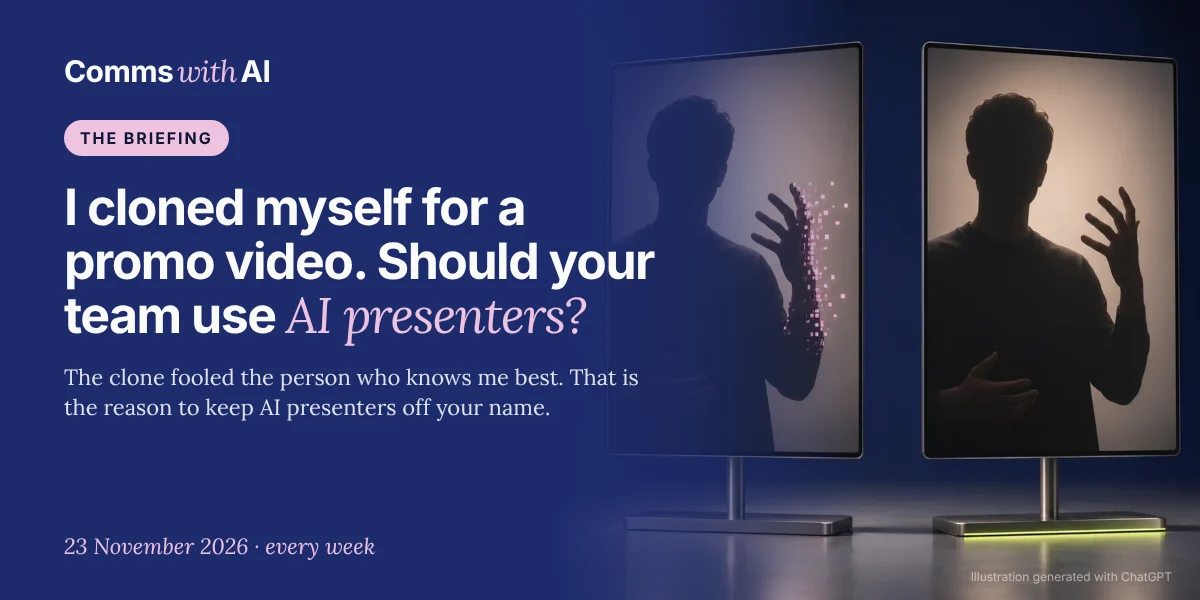
Last week I let AI clone me for a promo video, and the clone fooled the person who knows me best, which was a shock to the both of us! If someone offers your chief executive on video in 12 languages this week, here is what I would tell them… Though first:
From Comms With AI
I joined Ross Dawson on the Humans + AI podcast. Ross and I spent episode 64 (18 November) on how AI is changing internal and external comms: keeping a team’s foundation documents current, testing messages against personas, where human approval points and assurance gates belong in an AI workflow, and what it takes for an organisation to be credible to the AI agents that now read it, with a detour into the philosophy of language. The episode page has the full transcript and links to Apple Podcasts and Spotify. Listen on Humans + AI
Find what fits your team in one sentence. Our homepage now has a finder that reads as a sentence: “Show me what works for a head of comms or director at a charity in a team of 2 to 20, for AI rules and sign-off, in Microsoft Copilot.” Change any of the five choices (role, type of organisation, team size, task and AI tool) and the library’s templates, workflows, tool reviews and guides filter in place. Set one or two and leave the rest, and it still returns a starting set. It went live on Friday, so reply and tell me what it gets wrong – always keen for feedback, not least since the website is intended to show what’s possible (and as importantly what’s not possible) with current tools! Try the finder
From Applied
I cloned myself for a promo video. Why on earth would a comms team? (20 November), on Applied Comms With AI. I ran one 126-word promo script through Synthesia, HeyGen and Google Vids on their free or included plans. All three looked passable at a glance, and every one needed editing: Synthesia called my company “Fower”, HeyGen added a stranger walking through the office, and Google Vids captioned me “Michael McLeanen, founder of four”. Then HeyGen’s new Avatar 6 built a clone of me from one photo and a 22-second clip. It read the script in one take, closer to what I meant than I managed in my own attempt, and it fooled the person who knows me best. My advice is to keep AI presenters off your organisation’s name and write that line into your AI policy now, because the pitch is coming. The piece has the clips, and a poll where you can guess which one is me. Read on Applied
What the agencies are doing
Ogilvy and CAA now license AI doubles of celebrities. Ogilvy and the talent agency CAA have launched Echo, which lets CAA clients license AI versions of themselves built from scans in CAA’s 204-camera “Vault”. The talent approves every use, a watermark marks each asset as AI-generated and approved by the star, and Terry Crews is the first named to opt in; Digiday reports that it cuts the cost per asset by 65 to 75 per cent (Digiday, 9 November). This is the licensed, consented version of this week’s lead. If your organisation works with ambassadors or spokespeople, decide what you would allow and how you would disclose it before an agency brings you the deck. Read
Agencies are now scored on AI adoption. Growth consultancy Sprint Partners has launched SAM, a free tool that uses AI to rate PR and comms agencies against their peers on ten areas, AI adoption among them, with ratings reviewed by people before they are issued. Its Growth Pulse research with the PRCA finds 96 per cent of agency leaders expect growth in 2027, 26 per cent are achieving it now, and 65 per cent name client budget or fee pressure as the main barrier (PRmoment, 12 November). Expect AI to feature in your agency’s next pitch, and ask what it has changed in the work they deliver to you. Read
Anthropic hires Disney’s former communications chief. Kristina Schake, Disney’s chief communications officer for four years and before that the lead on the Biden administration’s Covid vaccine education campaign, joined Anthropic in October to lead corporate communications as the company lists on Nasdaq (PRovoke, 19 November). It follows OpenAI’s hire of Uber’s corporate affairs chief earlier this month. The AI companies are hiring senior crisis and consumer-brand communicators, a sign of how much reputation work they expect, and a reminder that your own suppliers’ reputations can become questions for you. Read
Tools and models
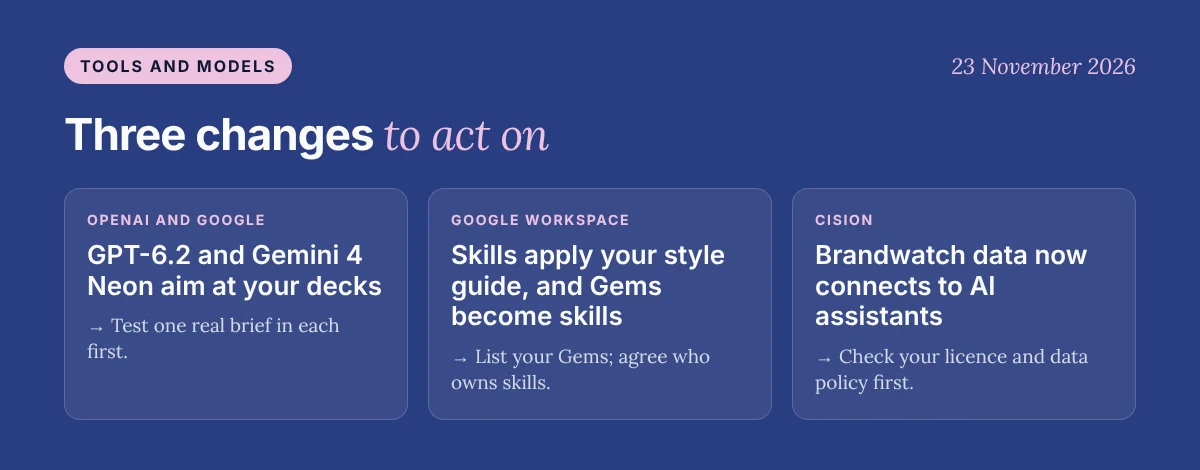
OpenAI and Google both aim new models at decks and documents. OpenAI has released GPT-6.2 Astra, its model “for your hardest projects”, and Sol, a cheaper model “for everyday work”, and says Astra’s slides, spreadsheets and documents “read less like AI, and more closely follow the templates you provide” (OpenAI, 17 November). A day later Google released Gemini 4 Neon, a mid-priced model it says turns spreadsheets, PDFs, charts, audio and video into structured deliverables; it is in the Gemini app for Pro and Ultra subscribers and in Gemini for business (Google, 18 November). If your team asks AI for decks in a house template, run one real brief through each new model and the one you use now, side by side, before anyone switches. The benchmark claims are the companies’ own. Read OpenAI’s post · Read Google’s post
Google Workspace can now apply your style guide for you. Skills, reusable instructions that hold a team’s rules, templates and reference files, are rolling out across Gmail, Docs, Slides, Drive, Chat and Workspace Studio. Gemini uses a skill when it judges it relevant, or when someone @mentions it. They are on by default for eligible Business and Enterprise editions, reaching Scheduled Release domains from 30 November, and are not yet in Sheets or Meet (Google, 10 November). In the Gemini app, Gems are being replaced by skills, from November for personal accounts and in 2027 for work accounts; Google will convert existing Gems automatically, but their knowledge files have to be downloaded and uploaded again (Gemini Apps Help). Write the house style and boilerplate once, list any Gems your team relies on, and agree who owns and reviews the shared skills before everyone writes their own. Read · Gems to skills
Cision connects its monitoring data to AI assistants. Cision has launched Cision Intelligence, an agentic layer over its data that starts with its Brandwatch agents (17 November), and the first release of a Cision MCP server, which lets outside AI tools and agents reach four Brandwatch Consumer Research functions: query management, quick insights, insights and summaries, and alerts (PRmoment, 20 November). With Adobe’s MCP earlier this month, the tools your team already pays for are starting to talk to its assistant. Check what your licence and data policy allow before anyone connects one, and test the answers on a past campaign you know well. Read
Test it yourself
Draft your line on AI presenters today
Paste the disclosure section of your AI policy into the assistant your team uses and run the prompt below. Take the draft to whoever signs off your policy this week, so the answer is written down before the first pitch for a synthetic spokesperson arrives. Our AI use policy template has a disclosure section to put it in.
Using our AI policy below, draft a clause of under 120 words on AI presenters and AI clones of real people: where we will never use them, who can approve an exception and how we would disclose one. [Paste policy]
Open the AI use policy template →Worth reading
- CEOs want a person to write their important speeches. The sixth HarrisX and Ragan survey of chief executives and communications leaders finds 52 per cent of CEOs would now rather a human communicator wrote an important speech, a 9-point swing; last year 57 per cent preferred an AI trained on their past speeches. 70 per cent say communicators equipped with AI tools remain vital (PR Daily, 13 November). It is the same question as this week’s lead, asked in the boardroom. The survey is from the US and the article does not give the sample size. Read
- A reputation that rests on one leader is a single point of failure. Paul Holmes links Jensen Huang’s departure from Nvidia and OpenAI’s year-long search for a chief communications officer to the cult of the founder across the AI sector, quoting Scott Galloway and the FT’s Richard Waters on “founder mode” (PRovoke, 22 November). It is the same diagnosis as our Applied piece from July on why AI is losing the communications war: the public case for AI is made by a few very wealthy leaders speaking at the public. Read beside this week’s lead, both ask who should speak for an organisation. Read · Our Applied piece
- The Global Alliance has rewritten its Responsible AI Principles. Its board approved the “Abuja Update” this month, consolidating seven principles into five commitments, among them human-led accountability and transparency and traceability (Global Alliance, November). If your AI policy cites the earlier principles, check the new wording at your next review, alongside the clause from Test it yourself above. Read
- Most regulated businesses have no crisis plan, and fewer than half have AI rules. Alder surveyed 250 UK decision-makers in five highly regulated sectors: 66 per cent are “very confident” they could handle a major reputational incident, yet 80 per cent have no formal crisis communications plan and 43 per cent have an established AI governance framework (PRmoment, 12 November). If you are missing either, write them together and run a tabletop before an incident forces one. Read
Events
This week
Elsewhere: Tuesday 24 November, 09:30 to 12:30 GMT: AI Agents for PR & Communications. A half-day online PRCA course with Andrew Bruce Smith on AI agents that plan, research and carry out multi-step tasks, with a governance framework and a 30-day pilot plan to take back to your team. £235 + VAT for members, £330 + VAT for others. See the listing
Elsewhere: Thursday 26 November, 09:30 to 15:30 GMT: Advanced AI. The CIPR’s online day for practitioners who have the basics and want practical, current advice on using AI in PR work. The price shows when you book, and members save up to £200. See the listing
Elsewhere: Thursday 26 November, 10:00 to 15:35 GMT: CharityComms AI Conference. An online day on leading AI strategy and building skills in charity comms teams. £120 to £295 + VAT, depending on membership. See the listing
Next week
Elsewhere: Monday 30 November, 09:30 to 15:30 GMT: Content Creation and Activation with AI. The CIPR’s online day on creating content with Copilot, ChatGPT and Gemini, for whoever drafts most of your team’s content. The price shows when you book. See the listing
Elsewhere: Thursday 3 December, 10:00 to 16:00 GMT: Copilot for Comms: An Introduction. The PRCA’s online day on Microsoft Copilot for comms staff, with no experience needed. Places are bookable again; £370 + VAT for members, £520 + VAT for others. See the listing
In two weeks
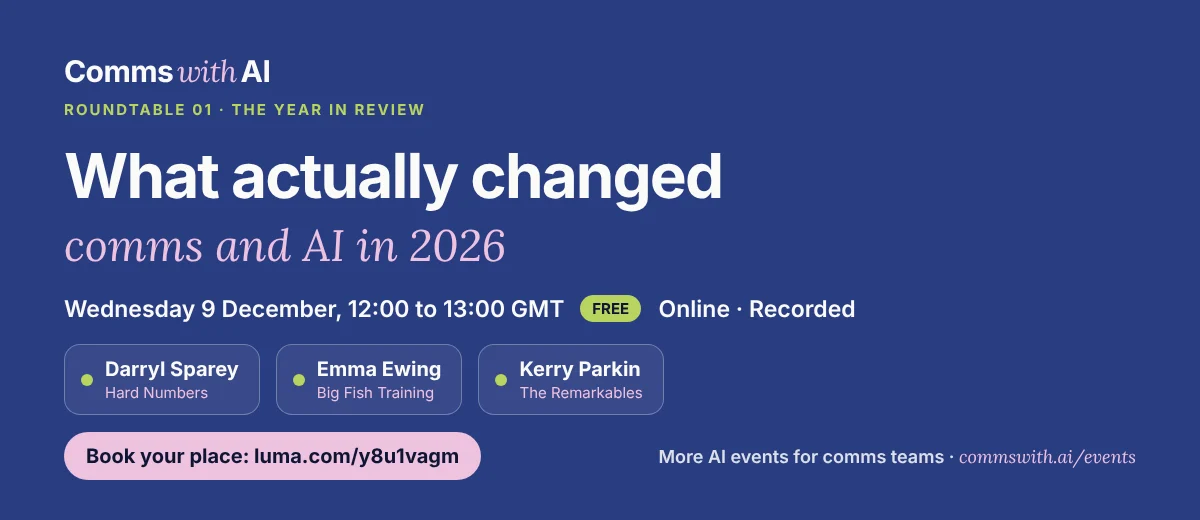
Wednesday 9 December, 12:00 GMT: What Actually Changed, Comms and AI in 2026. Our first Roundtable asks three people who watched the year closely what AI changed in how comms teams work, with every theme anchored in something published this year: Darryl Sparey of Hard Numbers, Emma Ewing of Big Fish Training and Kerry Parkin of The Remarkables. An hour, free, online and recorded. I also deliver training with Big Fish. Book on Luma
Every AI session for comms teams we know of, with filters, is at commswith.ai/events.
Talk it through. A Consult Comms With AI session is 45 minutes with Michael and a written advisory note you can act on. Book a session
Pass it on
Would you let an AI version of your chief executive speak for your organisation? Reply with yes, no or “only if”, and your reason in a sentence.
The Briefing now reaches more than 700 people by email or on LinkedIn. If someone on your team is facing the same question, forward this to them.
Reading a forwarded copy? Sign up at commswith.ai/applied, and your first email brings a one-page AI acceptable use note to adapt for your team.
– Michael