This is the second weekly Briefing, and we’re still experimenting with its format and frequency. Feedback is appreciated, as always: reply and tell me what you’d keep, cut or add. – Michael
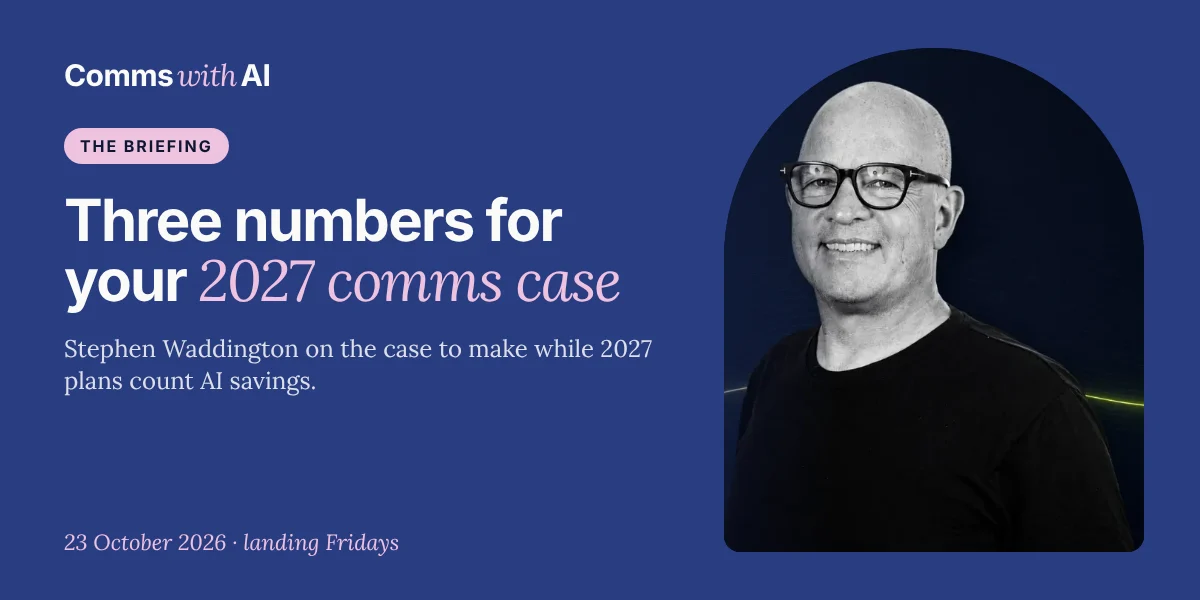
Stephen Waddington told me management looks at only three numbers, and with 2027 plans now asking comms teams to turn their AI use into savings, I think those numbers are where your case has to be made this autumn. This week also brings a new Guides section on the AI tools for each comms stream, a question every agent pilot should answer first, and a free check anyone can now run on your AI-made images.
From Comms With AI
A new Guides section: which AI tools to use for each job in your comms stream. Each guide is organised by job, says what each tool costs and which ones I use myself, links every tool to its entry in our directory, and says plainly where a general assistant such as Claude or ChatGPT now does the job. Every guide is dated and re-tested every three months, and the Briefing will tell you when one changes. Pick your stream:
- Internal comms: drafting, newsletters, video, meeting capture and the channel itself.
- Media relations and PR: finding journalists, pitching, monitoring, and checking what AI answers say about you.
- Crisis and issues: from early warning to the record afterwards, with Amanda Coleman’s advice to build your prompt library while things are calm.
- Public affairs: political monitoring, consultations, bills and stakeholder mapping, checked against Hansard and the free official record.
- Social media: scheduling, drafting, approvals, listening and replies, and what no tool should do on your account without a person.
- Executive comms: speeches, LinkedIn posts, board papers and decks, and the rules for voice clones and avatars of a real leader.
From Applied
Three numbers: Stephen Waddington on making the case for comms in 2027 (20 October), on Applied Comms With AI. Several of Stephen’s clients have been told, in 2027 planning, to turn their AI use into headcount and agency savings. His answer is to make the case in the three numbers management cares about (what communications adds to the top line, to operational savings and to intangibles), to defend the judgement work of strategy, counsel, crisis and listening, and to ask for new budget for new work such as AI visibility. The piece ends with three things to do before your plan goes in. Read on Applied
What the agencies are doing
Who answers for the agent? Jeremy Seow, formerly regional COO at Allison Worldwide and chief executive of WE Communications Singapore, has joined Sequencr AI as president and co-founder; its Stratum platform uses AI agents to monitor stakeholder narratives and run workflows (PRovoke, 21 October). His point for communications chiefs: once agents work on their own, someone has to decide “what authority those agents have, where human judgement remains essential” and “who is accountable when work moves between the two.” Write those answers down before an agent pilot starts. Read
The Publicis and LiveRamp terms make a checklist. The US Federal Trade Commission has proposed a consent order on Publicis Groupe’s $2.2 billion purchase of LiveRamp: five years of equal access for rival agencies, firewalls around customers’ confidential data, independent audits, and the right for customers to ask for an audit of their own data (PRovoke, 21 October). The FTC says it has not found any misuse. If your agency’s group owns the data and the tools it uses for you, ask what firewalls and audit rights you hold; the FTC’s terms are a ready list. Read
Monitoring suppliers are selling insight now. Broadcast intelligence platform eMedia Monitor has made Dr Maya Koleva, formerly research and insights director at Commetric, head of product as it moves further into AI and “narrative intelligence”; its chief executive says AI has let it move “beyond providing data to providing insight” (PRmoment, 20 October). Before an AI-written analysis reaches a board pack, ask the supplier how it was checked and where a person reviewed it. Read
Tools and models
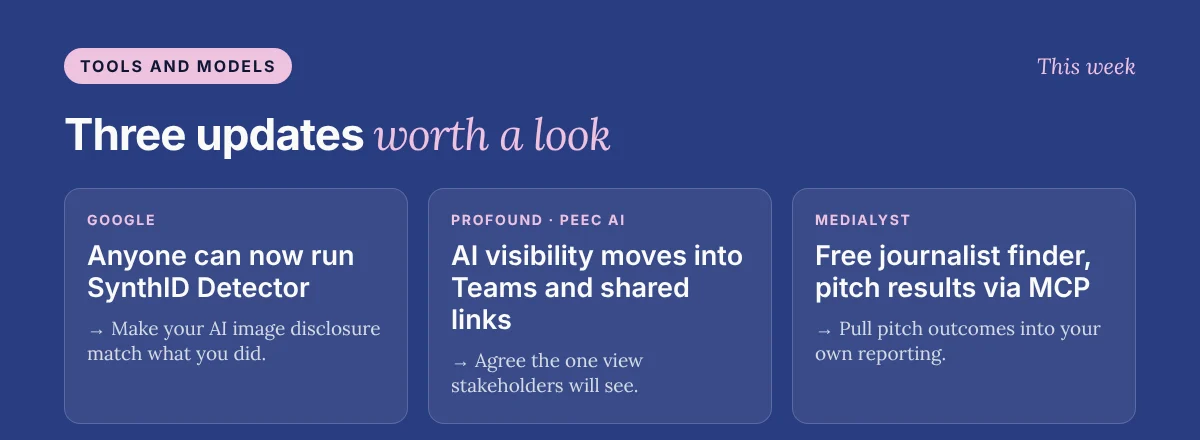
Anyone can now check whether a picture came from Google’s AI. Google DeepMind has opened SynthID Detector to everyone, globally, in English: it checks an image, video or audio file for the watermark used by Google and its partners, named as OpenAI, NVIDIA and Kakao, with Apple to follow (Google, 7 October). Journalists and critics can now run the same check on your visuals, so make sure your disclosure line on AI-assisted images says what you did. Read
AI visibility tracking is moving to where your team works. Profound now builds agents from a plain-language request, with triggers such as a 5 per cent shift in visibility, and has put its AI Marketer into Microsoft Teams (Profound changelog, 16 October). Peec AI now lets you save custom dashboards and share a read-only link, with an optional password, with people outside the tool (Peec AI, 14 October). Agree the one view your stakeholders will see, and what the number is for, before you send the link. Profound · Peec AI
Medialyst adds a free journalist finder. The media list tool, which joined our directory this week, has added a free Journalist Finder and now offers pitch results through its API and its MCP connector for AI assistants, with replies labelled positive, negative, out of office or no longer at the outlet (Medialyst changelog, 14 and 16 October). If you pitch from it, you can now pull those outcomes straight into your own assistant or report. Our first look
Test it yourself
Put your AI hours into three numbers
List the tasks AI helped your team with this month, the hours it released and where those hours went. Then open the Objectives & Measurement Framework, which starts from Stephen’s three numbers, and write one objective each for the top line, operational savings and intangibles.
Open the framework with Stephen’s numbers →Worth reading
- A media relations playbook, run by an influence operation. OpenAI says an Iranian operation placed almost 100 articles across about a dozen outlets under seven invented bylines, using ChatGPT to fit drafts to each outlet’s submission rules and to write the pitch emails; a Russian one ran a fake think tank and is the first OpenAI has rated at the top of its impact scale (OpenAI, 8 October). Expect editors to check contributors harder, and make your own bylines easy to verify. Read
- AI is now the change staff feel most. Edelman’s Trust at Work report finds AI integration was the most common workplace change of the past year, reported by 53 per cent of employees, while trust in employers fell from 79 to 74 per cent since 2024; 82 per cent trust their chief executive after a change that went well, 49 per cent after one that did not (PRovoke, 6 October). How you explain an AI rollout is part of the rollout. Read
Events
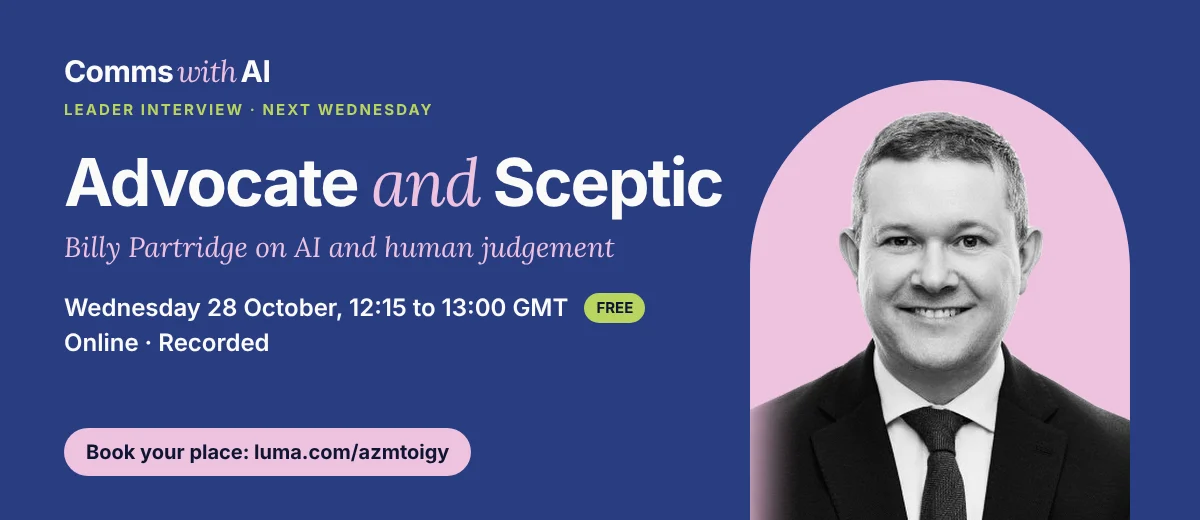
Wednesday 28 October, 12:15 GMT: Advocate and Sceptic, with Billy Partridge. Next Wednesday, Grayling’s UK chief AI officer makes the case that communications agencies have to be advocates for AI and sceptics of it at once, and we’ll talk about when an automated process should hand back to a person. Free, online and recorded, so register even if you can’t make the slot. I also work with Billy and Grayling as a freelance digital and social director. Book on Luma
Wednesday 18 November, 16:00 GMT: After Adoption, with Zoe Amar. Zoe, co-author of the Charity Digital Skills Report and chair of the Charity Digital Code of Practice, on what comes after a charity starts using AI: governance, AI imagery in sensitive areas, and how to talk to supporters about it. Charities answer these questions on tight budgets and in public view, so the answers travel well beyond the sector. Free, online and recorded. Book on Luma
Pass it on. If a colleague would find the Briefing useful, the signup is at commswith.ai/applied, and their first email brings a one-page AI acceptable use note to adapt for their team.
Talk it through. A Consult Comms With AI session is 45 minutes with Michael and a written advisory note you can act on. Book a session