Three weekly issues in, we’re still experimenting with the Briefing’s format and frequency. This week I’ve put one in-house team beside the agencies, to show what a comms team can now make for itself. Feedback is appreciated, as always: reply and tell me what you’d keep, cut or add. – Michael
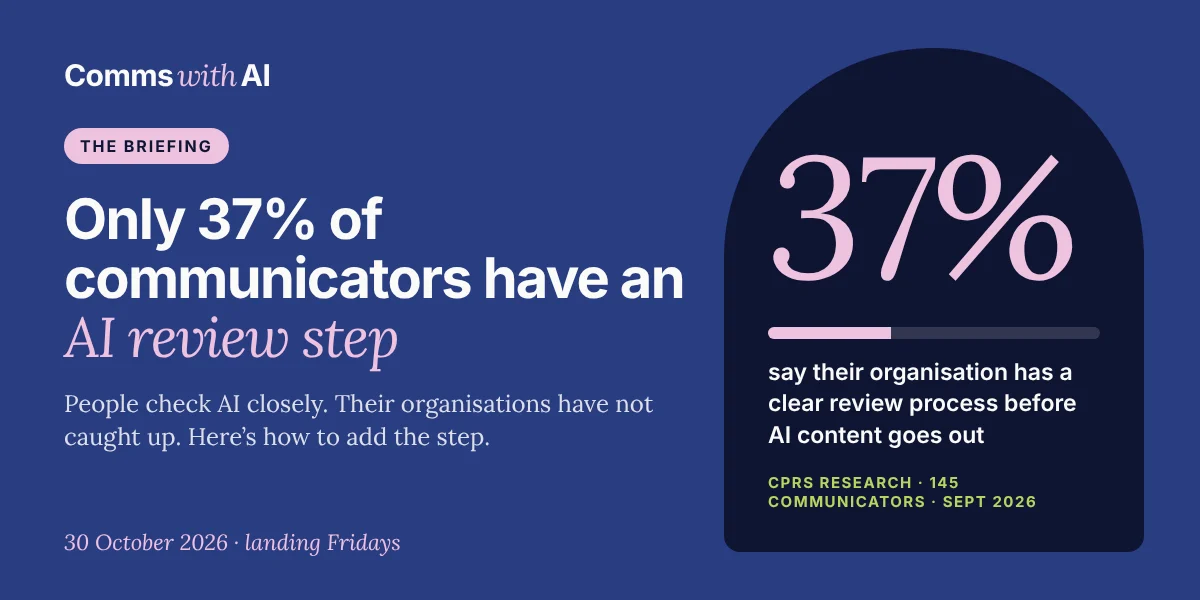
New Canadian research finds that 91 per cent of communicators who use AI check its answers, yet only 37 per cent say their organisation has a clear review step before AI content goes out. I think that gap is the cheapest risk in comms to close, so this week brings a five-minute daily AI log, a starter guide for colleagues new to AI, and the platform changes that make a written review step more urgent.
From Comms With AI
A five-minute habit that keeps your AI use on the record. The Daily AI Use Wrap-Up, new in the library’s Govern phase, turns a few rough lines about your day into one screen: what you did, every task where an AI tool was involved (which tool, what went in, in general terms, and whether you checked the output), one highlight and one thing to pick up tomorrow. It flags any tool that isn’t on your approved list, and by Friday the week’s logs are ready for your AI Use Review & Risk Log. If your approved assistant can run scheduled tasks, it can email you the log at the end of each working day. Open the template
From Applied
AI for comms: a starter guide to what you need to know in October 2026 (27 October), on Applied Comms With AI. Written for colleagues who are new to AI or use it now and then: where adoption stands in UK PR and charities, what ChatGPT, Claude, Gemini and Copilot are each good for in comms work, five tasks to try in one week with a risk level for each, the EU AI Act transparency duties now in force and the UK position, and a glossary. The core advice is to start with the tool your organisation already licenses and check every line before it leaves you. I’ll refresh it every quarter. Read on Applied
One paragraph, 55 minutes: why interactive guides are due a comeback in the age of AI (29 October). I borrowed a brief from Anthropic’s Boris Cherny and pointed it at our six-part AI Agent Series: about 80 words produced an illustrated, interactive companion in 55 minutes. Checking it took the rest of the day. A second model found bugs that Claude’s own tests had missed, and our claim ledger went through 504 claims, finding none false and 11 where a hedge or a detail had been lost. Making the thing is now quick, so the time and the skill move to checking it. The companion and a free-kick game Claude built are in the piece to try. Read on Applied
What the agencies are doing
Agencies are buying the measurement behind AI visibility. B2B agency Marketbridge has acquired Channel99, which runs a fixed set of buyer-style questions through ChatGPT, Claude, Gemini and Perplexity each week, and the two are launching an AI Visibility service (The Drum, 28 October). Channel99 finds that smaller challengers often outrank big brands in product comparisons, and says the models favour plain descriptions, comparisons and third-party references. The in-house lesson costs nothing: describe what you do in plain words and earn coverage from sources the models already trust. Read
Seven Letter takes AI-visibility audits into public affairs. The US firm has added Engine, which benchmarks how AI tools portray a client’s brand, executives or cause, then plans earned media, content and public affairs work to correct inaccuracies and counter misinformation, with monitoring and periodic re-audits (O’Dwyer’s, 28 October). If an agency offers you one of these, ask which questions it measures against and how it will show the change. Read
An in-house team made the anniversary film itself. Smiths Group’s in-house communications and creative team made “Smiths 175: An extraordinary journey”, which imagines founder Samuel Smith seeing the company today, using Higgsfield and Unreal Engine alongside traditional production. AI supported the concept, characters, script, storyboards and visuals; the team kept the narrative, art direction and final execution (Communicate, 28 October, written by Smiths’ Tom Steiner). Before your own AI video goes out, write down that split of who did what: it is the disclosure line you will need. Read
Tools and models
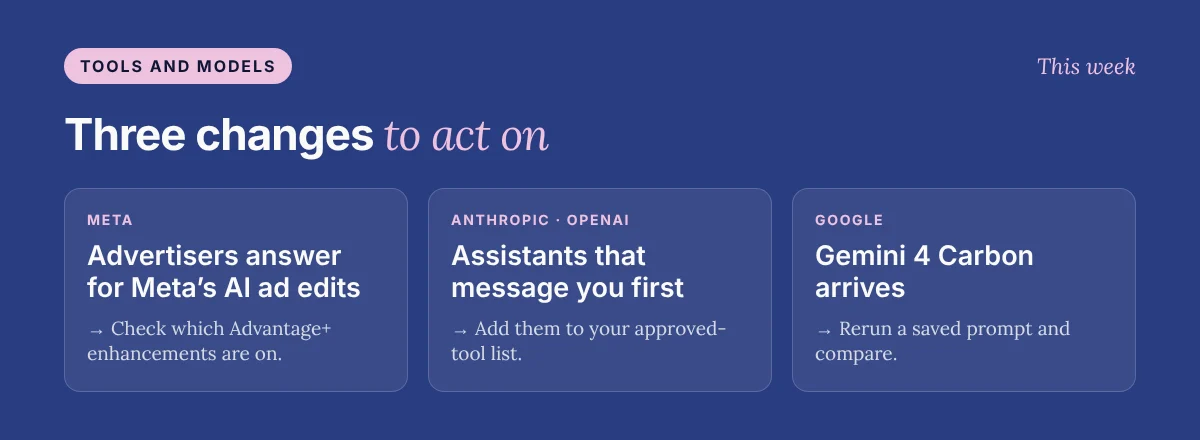
From today, Meta’s advertisers answer for its AI’s edits. Meta’s revised Commercial Terms add an “AI Features” section which, as Adweek reads it, makes advertisers solely responsible for anything Meta’s AI creates or changes in their ads, including features Meta switches on itself, such as Advantage+ creative enhancements. Meta says the features “may make mistakes”, and running ads after 30 October counts as accepting the terms (PPC Land, reporting Adweek, 22 October). Check which enhancements are on in Ads Manager, and switch off any that could change a claim, a face or a brand asset without sign-off. Read
Assistants that message you first. Anthropic has opened Claude Duet as a research preview, by waitlist for US Pro and Max subscribers: it sends a morning brief across your connected apps, flags what needs attention and works in the background, and it shows you what it plans and waits for approval before it sends a message, signs, pays or deletes (Anthropic, 21 October). OpenAI now lets people text ChatGPT’s proactive “dot” agents over iMessage or RCS, with the same context and plugins (9to5Mac, 28 October). An agent that staff can text from a personal phone sits outside most approved-tool lists, so add these to yours, and make “approve before it sends” the rule for any agent. Claude Duet · ChatGPT dot
Google releases Gemini 4 Carbon. Google’s new frontier model arrives two weeks after Argon, with claimed gains in coding, agentic tasks and multimodal understanding (9to5Google, 28 October); which Gemini plans get it had not been stated. If your team relies on saved Gemini prompts, rerun one and compare before trusting the output. Read
Test it yourself
Put every AI feature you didn’t switch on in the register
List the AI features your platforms have turned on for you, such as Meta’s Advantage+ enhancements, meeting summaries and inbox assistants, and any agent staff can message from a phone. Add each to the AI Tool Register with an owner, the data it may touch and its status, so your review step has something to check against.
Open the AI Tool Register →Worth reading
- Careful people, missing process. CPRS and Leger’s “From Adoption to Accountability” surveyed 145 Canadian communicators from 9 to 30 September: 92 per cent use AI at work, 37 per cent have seen an AI error reach clients, the public or the media, and 34 per cent say accountability for AI-caused reputational damage is clearly defined (CPRS, 27 October). The sample is small and self-selected, so treat the figures as indicative; its two main fixes, a second check on higher-risk work and a named owner for each AI-assisted piece, cost almost nothing. Read
- AI relations, five years out. Allison Carter, editorial director of PR Daily and Ragan, sets out six predictions for 2031, starting with “AI relations” as a discipline beside PR: getting content surfaced in AI answers and in front of AI agents that buy (Ragan, 13 October; found via Magdalena Gawlak). Decide now who in your team owns how the organisation appears in AI answers. Read
- A communicator built his own podcast monitoring. Stephen Davies of Adelbury tracks 37 UK political podcasts each week, counting who and what gets airtime: 104.7 hours across eight weekly editions from 28 August to 22 October. He says AI wrote most of the pipeline and does the transcribing, and he checks names, counts and method before each edition goes out (Adelbury Labs). Any team whose sector is discussed on podcasts could track its issues the same way. See the tracker
Events
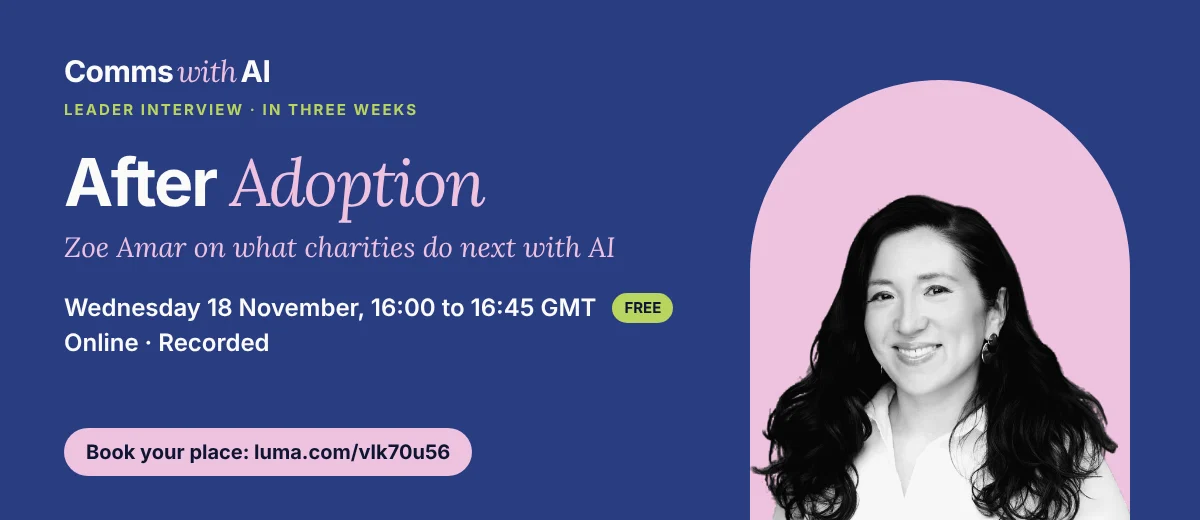
Wednesday 18 November, 16:00 GMT: After Adoption, with Zoe Amar. Once a charity is using AI, the harder questions start: who governs it, when AI imagery is right in sensitive work, and what to tell supporters. Zoe, who chairs the Charity Digital Code of Practice and co-authors the Charity Digital Skills Report, joins me to work through them, and the answers apply to any team that works in public view. Free, online and recorded. Book on Luma
Missed Billy Partridge? Our Leader Interview with Grayling’s UK chief AI officer ran on Wednesday, and the write-up and recording follow on Applied soon. I also work with Grayling as a freelance digital and social director.
Elsewhere: Wednesday 18 November, 09:30 to 16:00 GMT: AI for Communications Professionals. Westminster Insight’s one-day live online course, led by trainer Anil Manji, for comms, PR, marketing, digital and internal comms staff with no prior AI experience; 6.5 CPD hours, and attendees need access to Copilot. Price on enquiry. Course page
Pass it on. If a colleague would find the Briefing useful, the signup is at commswith.ai/applied, and their first email brings a one-page AI acceptable use note to adapt for their team.
Talk it through. A Consult Comms With AI session is 45 minutes with Michael and a written advisory note you can act on. Book a session